Introducing Louis Kurz
 |
| Louis Kurz |
This is the first part of a series where I look at the historical lithographs of Louis Kurz. I was going to start with his Civil War works, but I saw a particularly baffling depiction of an event in 1890 and decided to start with his three portrayals of Indian War battles. Louis Kurz was an Austrian immigrant who got into lithographic art with Alexander Allison (they co-ran an art firm in Chicago). His colored works utilized chromolithography, where ink is printed onto black and white drawings. These cheap forms of art could be reproduced and purchased for display in family homes.
Louis Kurz was a Union Civil War veteran and produced a series of battle depictions. His aim was to instill patriotism and there is a definite Unionist slant. Despite his actual involvement in the war he did not strive for accuracy. Despite the simplistic nature of the art and numerous inaccuracies, his work has somehow grabbed the attention of many (myself included) and frequently adorns book covers and illustrated histories. Though known for his Civil War works, he also depicted battles from other events, foremost the Spanish-American War.
My objective in this series is to display Kurz’s art and make a few comments, especially on the inaccuracies. One general inaccuracy is the lack of diversity among uniforms and faces. Most of the soldiers have the same face with differing amounts of facial hair. They also are neatly attired. This is more noticeable in his depiction of Confederate soldiers, who historically had to improvise their garb and often wore butternut instead of gray (the common color for them in these lithographs. Now let’s look at Kurz’s three Indian War pieces.
Battle of Tippecanoe
I’m not as familiar with this event. The Battle of Tippecanoe saw Governor William Henry Harrison (famous as the shortest-running president) defeat Tecumseh’s Confederacy of American Indians. Tecumseh surprise attacked the American force, but the battle ended in the latter’s victory and the burning of Prophetstown, the center of the Indian Confederacy. Though this set back Tecumseh and his brother Tenskwatawa’s dream of ending American expansion, they were able to rebuild their forces and participate in the War of 1812.
Harrison can be seen at left on horseback, urging his men on. The only major inaccuracy I can discern is the uniforms of the Americans. Here they are wearing caps from the Mexican War era instead of shako hats.
Battle of the Big Horn
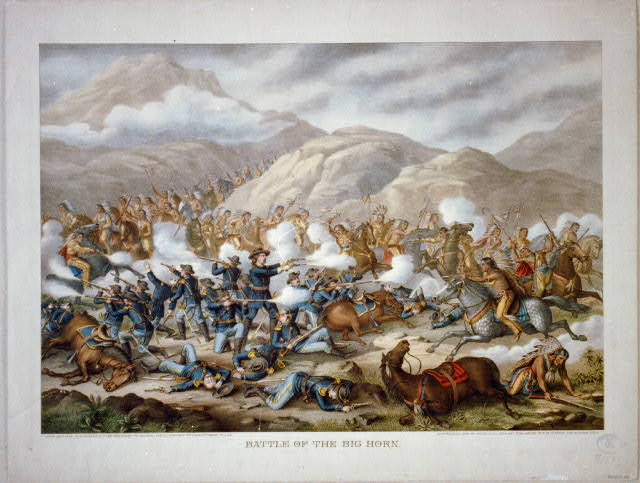
The Battle of Little Bighorn was the last big hurrah for the Sioux Indians. Custer set out to strike at Sitting Bull and Crazy Horse’s assembly of warriors (from several Indian groups). Lieutenant-Colonel George Armstrong Custer made the mistake of splitting his force in two against a larger force. While he had some men hold off Marcus Reno’s wing, he sent the bulk of his force against Custer’s and encircled it, killing every man. It’s one of the famous last stands in history and cemented Custer as an American icon.
Naturally Kurz would take a stab at Custer’s Last Stand. Custer can be seen dual-wielding revolvers and is surprisingly not wearing his famous jacket and red scarf. The American cavalrymen also look a bit too fancy. The most unusual aspect of this depiction is the terrain. The battle was fought on grassy plains and hills. Here the Indians are issuing forth from rocky mountains.
Capture & Death of Sitting Bull
Even for a Louis Kurz work this is an astonishingly inaccurate portrayal of a historical event. It might have been based off propaganda that obscured a nasty pair of linked incidents in American history. Here Sitting Bull dies in battle leading his Sioux warriors from their camp of teepees. The Federal cavalry is backed by artillery. The problem is that most of the violence occurred at the Wounded Knee Massacre. Sitting Bull was killed days earlier. Kurz is merging his death with the Wounded Knee event. Also the reservation-bound Sioux would not have had such a full military force complete with mounted warriors.
Here’s what really happened. The Indian Agent on the Sioux Reservation feared that Sitting Bull would lend his credibility to the new ghost dance movement. The Reservation police (actually fellow Sioux) went to his house and arrested him between 5 and 6 in the morning. Sitting Bull and his wife refused to go and woke up the rest of the camp with their protests. The police finally tried to force Sitting Bull to come with them. An angry man intervened and shot the leading policeman. Instead of turning on his attacker, the officer pointed his revolver at Sitting Bull and shot him in the chest. Another policeman finished him off with a bullet to the head. A full shootout broke out, with eight policemen and at least several Sioux dying. It was an ugly incident where the police and Sitting Bull's supporters let their emotions run loose, hardly an epic battle between Sioux warriors and Federal soldiers. The Wounded Knee Massacre did see the Sioux shoot it out with Federals, but it was also a far cry from Kurz’s depiction, which does not show the women and children who were gunned down in the fracas. Of course such accuracy would not have been a pleasant thing to mount on the wall of one’s home.