Showing posts with label louis kurz. Show all posts

Monday, November 14, 2022

Kurz & Allison Part X: 1865

 The Confederacy died in 1865. The major battles of that year were all Union victories and mercifully shortened the war. Louis Kurz shows three of the significant actions which spelled out the death knell of the Confederacy. He also produced a fourth lithograph that to my knowledge has been absent from illustrated histories, likely because it was printed without color and does not encapsulate a battle.

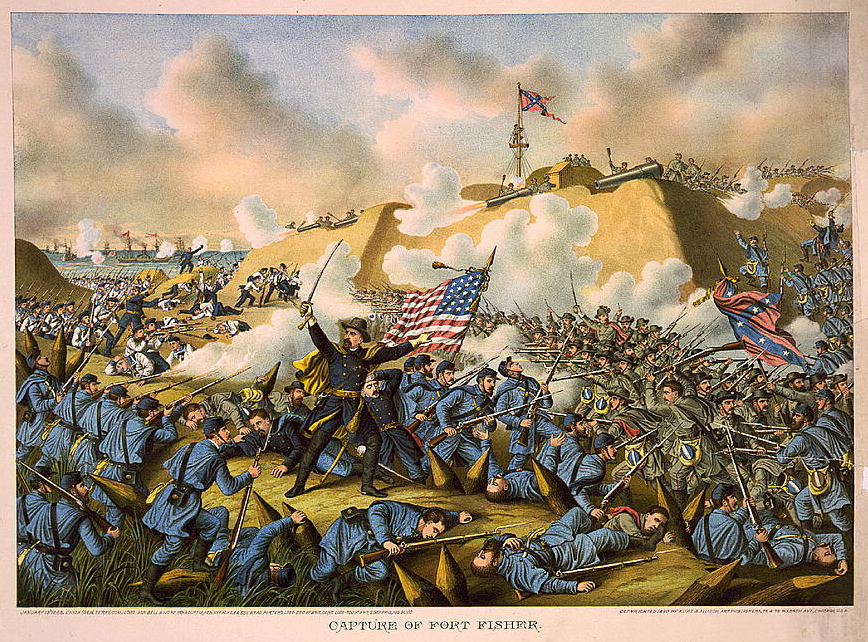
Capture of Fort Fisher

By 1865, the only Confederate port able to receive blockade runners and keep the Confederate forces, especially Lee's Army of Northern Virginia, alive was at Wilmington, North Carolina. The Union had held off on closing this port because the formidable Fort Fisher stood in the way. In early 1865 they finally made a move on it. The Navy under Admiral David Dixon Porter and a Corps of infantry under General Alfred Terry coordinated a controversially unchallenged landing on January 13 and an assault on January 15. Not properly supported by Confederate units miles away, the Confederate garrison under General George Whiting put up a stout defense, but eventually felt compelled to surrender. This cut the last major lifeline to Trans-Atlantic trade.

Thursday, October 27, 2022

Kurz & Allison Part X: Late 1864

 While General Grant and the Army of the Potomac were still stuck at Petersburg, the Union scored various victories in late 1864 that hastened the end of the Confederacy and ensured Abraham Lincoln's reelection as President. Naturally Union veteran Louis Kurz would feature some of these victories in his lithographs, two from Union General Phil Sheridan's Shenandoah Valley Campaign and two from Confederate John Bell Hood's ill-devised Tennessee offensive.

Battle of Opequan or Winchester

The title for this lithograph is somewhat misleading. Opequan is in fact spelled Opequon and this is the Third Battle of Winchester. To be fair to Kurz this is the largest Winchester battle of the war (Winchester changed hands at least 72 times). This was a major battle of the 1864 Shenandoah Valley Campaign. General Jubal Early and his Confederates had been running rampant, even approaching Washington D.C. itself. Newly arrived the aggressive Sheridan was determined to end his run. On September 19 he assailed the Confederates along Opequon Creek. The Federals broke through, only to be repulsed by canister fire. General Wesley Merrit's cavalry brigade got into the Confederate rear and after confused fighting Early withdrew to Fisher's Hill, the site of the next battle. This started a string of defeats for the Confederates in the Valley.

Thursday, October 13, 2022

Kurz & Allison Part IX: Atlanta Campaign

 While Grant oversaw what was hopefully the final offensive in Virginia, General William Tecumseh Sherman led three armies (Army of the Tennessee, Army of the Cumberland, and Army of the Ohio) on a drive to the vital railroad and communications hub of Atlanta, Georgia. General Joseph E. Johnston led the Confederate resistance. Sherman tried to outmaneuver Johnston while the Confederate commander attempted defensive battles to compensate for his numerical inferiority. Louis Kurz selected three battles from this campaign for his lithographs.

Battle of Resaca

Resaca was the first major battle of the campaign. General James B. McPherson’s Army of the Tennessee had an opportunity to get around the left of the Confederates and into their rear, thus trapping them. He failed to act on it. As a result timely reinforcements under General Leonidas Polk were able to reach Johnston and force the Union into a headlong battle from May 13-15. Johnston ordered a retreat as Sherman again threatened to cut into his rear.

Wednesday, September 28, 2022

Kurz & Allison Part VIII: Overland Campaign

When Ulysses S. Grant became commander of all Federal forces at the start of 1864, he chose to personally oversee operations in Virginia, practically commanding the Army of the Potomac (General George Meade was still the technical commander, causing tension among the Union leadership). The ensuing campaign, which lasted through May and most of June, was a constant, hellish series of battles that saw high casualty rates among both Federals and Confederates.

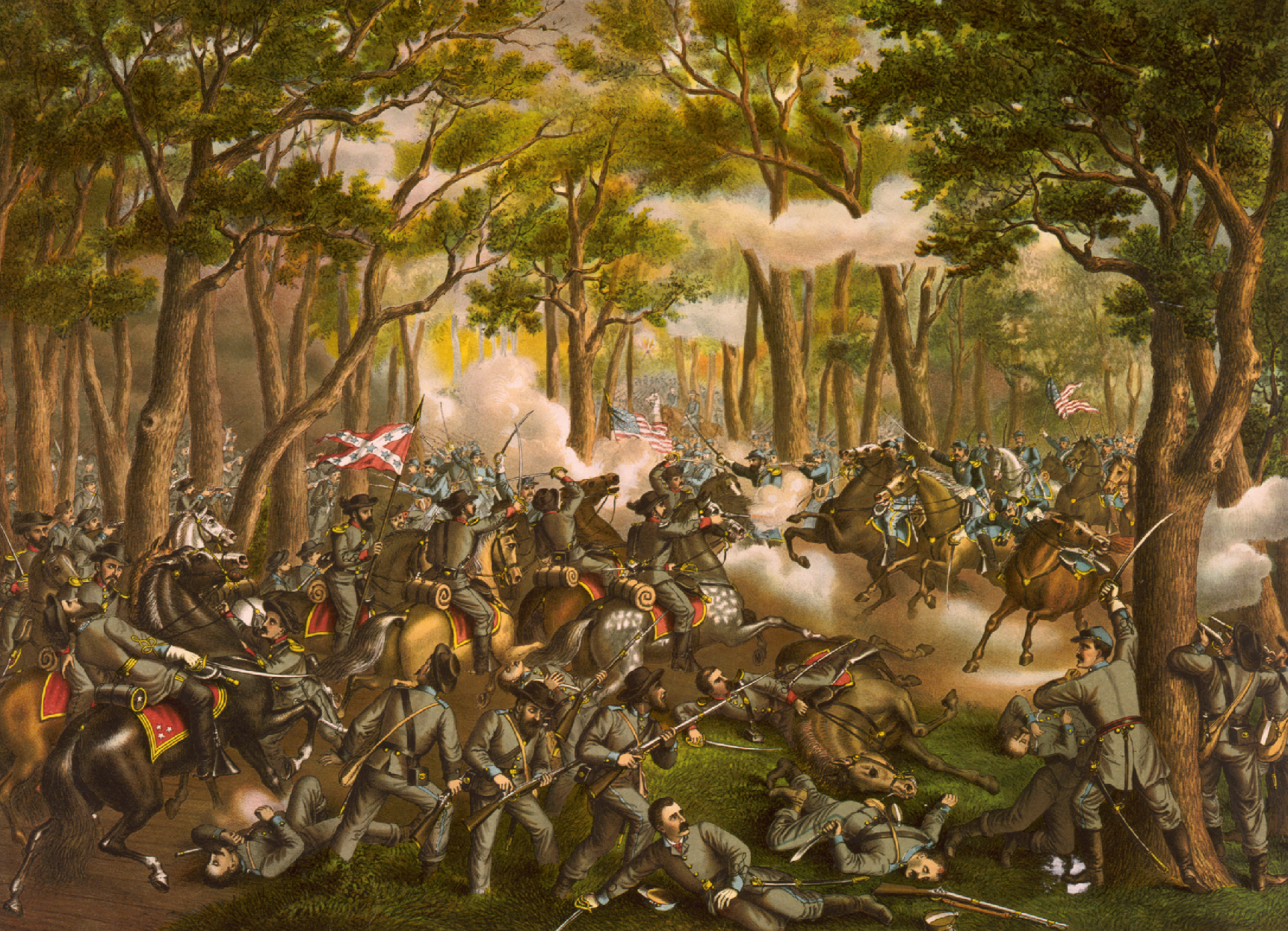
Battle of the Wilderness

The Wilderness is a wooded area. In fact it is part of the terrain over which the Battle of Chancellorsville was fought. Grant planned to get around Lee by quickly penetrating the dense forest. General Lee, however, blocked him on May 5 and a confusing and bloody battle ensued. It looked like the Federals would push through anyways on May 6, but reinforcements under General James Longstreet stopped them. The weather was dry and the vegetation caught on fire, burning many of the wounded alive. Tactically the Wilderness was a Confederate victory, but Grant simply marched his arm southeast and continued the campaign. His plan was to wear down Lee’s force through sheer attrition, as the North could much more easily replace its losses.

Wednesday, August 24, 2022

Kurz & Allison Part VII: Black Regiments

 Many white Union veterans had a deep respect for their black comrades in arms (check out Barbara Gannon’s The Won Cause, which shows how discrimination against blacks among veterans’ organizations was actually the exception rather than the rule). Louis Kurz was evidently among them, as he depicted black soldiers in a favorable light. I’ve already covered his use of helpful black civilians in the Monitor-Merrimac lithograph. This section contains three examples covering events from mid-1863 to early 1864.

Storming Fort Wagner

The summer of 1863 saw many attempts to capture the birthplace of secession: Charleston, South Carolina. In July General Quincy A. Gilmore sought to force Fort Sumter’s capture or surrender by seizing Morris Island and its Battery Wagner as a launching pad. The Federals landed on the island, but were not able to take the main objective. On July 18 the 54th Massachusetts, a regiment with Abolitionist white officers and mostly free northern blacks in the enlisted ranks, led a costly assault on Battery Wagner. The heavily outnumbered Confederates managed to repel the Union assault and only protracted siege warfare led to their abandonment of their post. Though a defeat, the battle proved to many that black soldiers could fight just as well as whites.

Thursday, August 11, 2022

Kurz & Allison Part VI: The Battles for Chattanooga

 Given that he operated out of Chicago, it was only natural that Kurz would focus much of his work on the glorious moments of the Army of the Cumberland (Illinoisans and other Midwesterners were heavily represented in this army) in the Chattanooga and Atlanta Campaigns. He extensively covered the former, producing a lithograph for three of the main actions outside the Tennessee transportation hub. First, we’ll look at the battle that turned General George Thomas into a national hero.

Battle of Chickamauga


In the summer of 1863 General William Rosecrans’ Army of the Cumberland skillfully maneuvered General Braxton Bragg’s Army of Tennessee out of Chattanooga. Though Rosecrans captured all his objectives in Tennessee, the War Department was annoyed that he had not brought the Confederates into a major battle so he could crush them. Feeling intense political pressure, Rosecrans marched into Georgia. James Longstreet’s Corps arrived from Virginia to bolster Bragg’s force and the Confederates attacked the Federals near the creek of Chickamauga. Thanks to a mix-up, the Federals accidentally opened a hole in their line. The Confederates exploited this and shattered their right flank. General Thomas was able to form a defensive line on Snodgrass Hill and hold off the enemy so the rest of the army could escape. For this he was called the “Rock of Chickamauga.” Occurring on September 19-20, it was the second bloodiest battle of the Civil War and the largest (albeit pyrrhic) Confederate victory in the western theatres.

Thursday, July 21, 2022

Kurz & Allison Part V: The Summer of ’63

 Mid-1863 saw several battles and campaigns that put military momentum solidly with the Union. Many consider this the turning of the tide, though it can be argued that the Union  was once on the verge of winning in mid-1862 and the Confederacy actually made some comebacks in 1864.

Battle of Chancellorsville


After restoring morale and efficiency within the Army of the Potomac, General Joseph Hooker attempted a flanking movement across the Rappahannock against Lee’s Confederate forces. He actually placed the heavily outnumbered Lee in a tricky situation near Chancellorsville at the start of May 1863. On May 2 General “Stonewall” Jackson executed an incredible flank march that routed the Union right. Jackson was hit by friendly fire (he would actually die of pneumonia instead of his wounds) while Hooker suffered a concussion that affected his judgment. The next day the Confederates were able to drive the Federals back across the river. Despite accomplishing one of his most celebrated victories, Lee believed that he could not afford any more such bloody battles.

Kurz focuses on the events of May 2. He shows the Union troops withdrawing towards the background, where artillery covers their retreat. The centerpiece, however, is the wounded Jackson. It looks like he’s been hit by a lucky enemy bullet rather than friendly fire. All the Confederate soldiers are ahead of him attacking the Federals. Also, Jackson was hit at night while reconnoitering ahead of his lines, not during  the height of the daylight action. Obviously Kurz wanted to show the infamous shooting while still displaying a battle vista.

Battle of Champion Hills


This is the first of two lithographs covering the Vicksburg Campaign. After a string of failures to take the last Rebel bastion on the Mississippi River, General Ulysses S. Grant finally put together his magnum opus. With the help of the Navy he was able to quickly slip his army from north to south of Vicksburg and cross back over the Mississippi (into the state of the same name). What followed was a string of battles where Grant defeated disunified Confederate forces. Champion Hill (called Champion Hills for the lithograph) was one of the more crucial encounters. On May 16 Grant struck General Louis Pemberton’s main force at the considerable height of Champion Hill. The Federals first flanked and then smashed through the Confederate lines, taking the nearby crossroads. The battle forced Pemberton towards Vicksburg with no escape route, ensuring a siege.

I am not as acquainted with this battle so I might miss a couple inaccuracies or neat references to real locations and figures. The Confederates in the foreground are notably more diverse in their clothing, especially the prisoners. Those on the right in front of the formidable Champion Hill sport a battle flag with inverted colors for St. Andrew’s Cross and the stars. The mounted figure leading his men on with his hat is General John Logan, who got into the Confederates’ flank. Logan was a political general from Illinois who enjoyed more success than others of his kind, possibly because his aggression worked well with Grant and Sherman’s battle plans.

The Battle of Gettysburg

The bloodiest (and almost largest) battle on North American soil, Gettysburg occurred from July 1 to 3. Lee, looking for a quick blow to end the war, invaded the North for the second time. Through a series of mistakes and circumstances, the two sides blindly struck each other north of the crossroads town of Gettysburg, Pennsylvania. On the first day Confederates pushed the Federals south through the town. The Army of the Potomac, now under General George Meade, took the heights south of town and narrowly repulsed a series of attacks on the second day. The third day cemented the Confederate defeat when Lee’s major assault on the Union center turned into a bloodbath. This was the first and perhaps only massive tactical defeat for Lee.

As with most artists who choose one part of the battle, Kurz focuses on Pickett’s Charge, the ill-devised July 3 assault on Cemetery Ridge. This is definitely one of his more cluttered works and I have to say not as striking. Masses of men from both sides advance from the sides of the lithograph. A wrecked Union battery shows the work of the incredible pre-assault bombardment (which was actually ineffective thanks to untested ordnance). A clump of Confederate prisoners are escorted off while a thick line of men snakes over the stone wall. The fence along Emmitsburg Road can be made out behind a shell-struck group of Rebels. If the dying officer on horseback is supposed to be General Lewis Armistead, Kurz forgot he was on foot for the whole charge.

Siege of Vicksburg

The Siege of Vicksburg lasted from May 18 to July 4. Grant made several attempts to take the city by force, all of which failed. Bombardments, though terrifying to the civilians, also did not wear down Confederate resistance. It was starvation that finally forced the loss of the city. Pemberton was supposed to get relief from General Joseph Johnston to the east, but Johnston dallied. Relief attempts from the Trans-Mississippi came too late and ended in defeat anyways. On July 3 Pemberton opened up talks of surrender, which were finalized the following day. Combined with the defeat at Gettysburg, this was a disaster for the Confederacy, giving the Union unrestricted access along the Mississippi River.

This is one of the more placid works, though there is still some action. Shells burst among the entrenchments and Union gunboats patrol the Mississippi River. For once some of the soldiers are shown not fighting. Many are actually lounging about, in great contrast to all the activity on the left side of the lithograph. In the right foreground an officer directs Grant’s attention (to what we don’t know). A Confederate party carrying a white flag emerges from the trees. It could be a flag of surrender, but the tiny red cross in one corner indicates it may be something else.

Thursday, July 14, 2022

Kurz & Allison Part IV: Late 1862

Surprisingly, Louis Kurz skipped battles from the summer of 1862, even though this period included the ascent of Robert E. Lee as head of the Confederate Army of Northern Virginia. Perhaps as a former Union soldier living in a Northern city, Kurz felt no special need or pressure to present such moments as the Second Battle of Bull Run. This part of the series covers the battles of late 1862.

Battle of Antietam

Kurz & Allison — Meet the Two Artists Whose Colourful Civil War  Illustrations Captivated the Public - MilitaryHistoryNow.com

After scoring a series of victories over the summer, Lee attempted an invasion of the North in hopes of riding his momentum to a decisive victory. However his army was severely understrength and once the Union Army under General George McClellan marched in force against him, he found himself desperately holding off waves of Federal attacks near Antietam Creek (outside Sharpsburg, Maryland) on September 17. The battle was tactically indecisive, but saw the end of his first northern invasion. It is bloodiest single day of combat in American history. Many also credit it with strengthening Lincoln’s political hand so that he could deliver the Emancipation Proclamation.

Thursday, July 7, 2022

Kurz & Allison Part III: Early 1862

In part three of this series I look at five Louis Kurz lithographs depicting battles from the first few months of 1862. The emphasis appears to be on Union victories, which is no surprise given Kurz’s background and Chicago location.

Battle of Fort Donelson

40276

Fort Donelson was one of the two forts guarding access the Tennessee River. Since the navy was unable to ground it into submission as it did Fort Henry, General Ulysses S. Grant had to start siege operations. The heaviest fighting came when the Confederates attempted to break out. They actually had a chance to escape, but their trio of incompetent commanders passed on it. The fort surrendered on February 16 and the Union now had a major invasion route into the South.

Thursday, June 23, 2022

Kurz & Allison Part II: First Battles

 Here’s part two of this series where I look at Louiz Kurz’s historical lithographs. For more context check out the opening of part 1. This second part will look at his depictions of Civil War battle from 1861. There are only two.

Battle of Bull Run

The First Battle of Bull Run (or First Manassas) was the first major battle of the Civil War. A Union army under General Irvin McDowell was rushed into the field against an equally green Confederate force under Generals Pierre G.T. Beauregard and Joseph E. Johnston. After a series of blunders, many which ended with friendly fire because of the inconsistent uniforms, the Confederates gained the upper hand at Henry House Hill and the Federals were routed.

Wednesday, June 15, 2022

Kurz & Allison Part I: Indian Wars

 Introducing Louis Kurz

Louis Kurz

This is the first part of a series where I look at the historical lithographs of Louis Kurz. I was going to start with his Civil War works, but I saw a particularly baffling depiction of an event in 1890 and decided to start with his three portrayals of Indian War battles. Louis Kurz was an Austrian immigrant who got into lithographic art with Alexander Allison (they co-ran an art firm in Chicago). His colored works utilized chromolithography, where ink is printed onto black and white drawings. These cheap forms of art could be reproduced and purchased for display in family homes.

Louis Kurz was a Union Civil War veteran and produced a series of battle depictions. His aim was to instill patriotism and there is a definite Unionist slant. Despite his actual involvement in the war he did not strive for accuracy. Despite the simplistic nature of the art and numerous inaccuracies, his work has somehow grabbed the attention of many (myself included) and frequently adorns book covers and illustrated histories. Though known for his Civil War works, he also depicted battles from other events, foremost the Spanish-American War.

My objective in this series is to display Kurz’s art and make a few comments, especially on the inaccuracies. One general inaccuracy is the lack of diversity among uniforms and faces. Most of the soldiers have the same face with differing amounts of facial hair. They also are neatly attired. This is more noticeable in his depiction of Confederate soldiers, who historically had to improvise their garb and often wore butternut instead of gray (the common color for them in these lithographs. Now let’s look at Kurz’s three Indian War pieces.

Battle of Tippecanoe


I’m not as familiar with this event. The Battle of Tippecanoe saw Governor William Henry Harrison (famous as the shortest-running president) defeat Tecumseh’s Confederacy of American Indians. Tecumseh surprise attacked the American force, but the battle ended in the latter’s victory and the burning of Prophetstown, the center of the Indian Confederacy. Though this set back Tecumseh and his brother Tenskwatawa’s dream of ending American expansion, they were able to rebuild their forces and participate in the War of 1812.

Harrison can be seen at left on horseback, urging his men on. The only major inaccuracy I can discern is the uniforms of the Americans. Here they are wearing caps from the Mexican War era instead of shako hats.

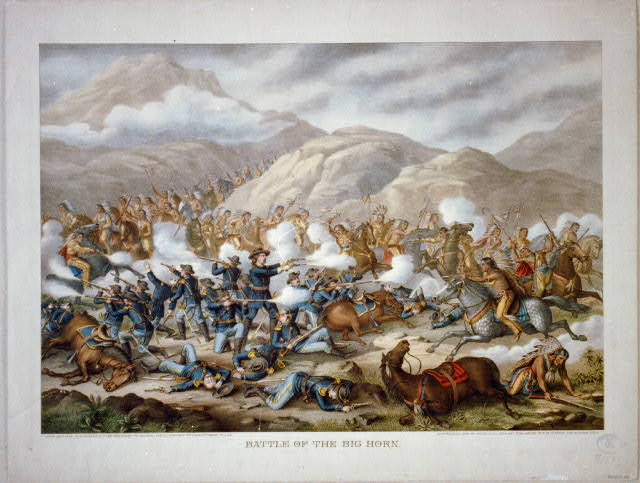
Battle of the Big Horn


The Battle of Little Bighorn was the last big hurrah for the Sioux Indians. Custer set out to strike at Sitting Bull and Crazy Horse’s assembly of warriors (from several Indian groups). Lieutenant-Colonel George Armstrong Custer made the mistake of splitting his force in two against a larger force. While he had some men hold off Marcus Reno’s wing, he sent the bulk of his force against Custer’s and encircled it, killing every man. It’s one of the famous last stands in history and cemented Custer as an American icon.

Naturally Kurz would take a stab at Custer’s Last Stand. Custer can be seen dual-wielding revolvers and is surprisingly not wearing his famous jacket and red scarf. The American cavalrymen also look a bit too fancy. The most unusual aspect of this depiction is the terrain. The battle was fought on grassy plains and hills. Here the Indians are issuing forth from rocky mountains.

Capture & Death of Sitting Bull


Even for a Louis Kurz work this is an astonishingly inaccurate portrayal of a historical event. It might have been based off propaganda that obscured a nasty pair of linked incidents in American history. Here Sitting Bull dies in battle leading his Sioux warriors from their camp of teepees. The Federal cavalry is backed by artillery. The problem is that most of the violence occurred at the Wounded Knee Massacre. Sitting Bull was killed days earlier. Kurz is merging his death with the Wounded Knee event. Also the reservation-bound Sioux would not have had such a full military force complete with mounted warriors.

Here’s what really happened. The Indian Agent on the Sioux Reservation feared that Sitting Bull would lend his credibility to the new ghost dance movement. The Reservation police (actually fellow Sioux) went to his house and arrested him between 5 and 6 in the morning. Sitting Bull and his wife refused to go and woke up the rest of the camp with their protests. The police finally tried to force Sitting Bull to come with them. An angry man intervened and shot the leading policeman. Instead of turning on his attacker, the officer pointed his revolver at Sitting Bull and shot him in the chest. Another policeman finished him off with a bullet to the head. A full shootout broke out, with eight policemen and at least several Sioux dying. It was an ugly incident where the police and Sitting Bull's supporters let their emotions run loose, hardly an epic battle between Sioux warriors and Federal soldiers. The Wounded Knee Massacre did see the Sioux shoot it out with Federals, but it was also a far cry from Kurz’s depiction, which does not show the women and children who were gunned down in the fracas. Of course such accuracy would not have been a pleasant thing to mount on the wall of one’s home.