Showing posts with label gettysburg. Show all posts

Monday, May 11, 2026

Americas 250th Birthday Cinemathon #23: Gettysburg (1993) part 2 of 2


Fremantle (James Lancaster) carries tea, because he's British, you see.

Arthur Fremantle

Before I get into a general rundown of the battle scenes and a few other points, I should provide some background on Lieutenant-Colonel Arthur Fremantle (James Lancaster). A British officer, he wanted to see the American War up close, particularly from the Southern side. Believing him an official observer, the Confederates gave him access to various major generals and politicians. Amusingly, however, Fremantle was actually on a leave of absence, and this was his idea of a vacation. He had quite the trip, starting with a pursuit by a Union blockade vessel, getting a look at Texas, and viewing Bragg’s Army of Tennessee.

Then he got to personally travel with the Army of Northern Virginia to Gettysburg. After witnessing the greatest American battle, he  traveled to New York for departure, arriving just in time to witness the infamous Draft Riots. He published his experience in the book Three Months in the Southern States. In the movie Fremantle adds a little color (literally with his inaccurate red uniform) and humor while getting the Confederate characters to open up about their causes and beliefs. In a wider-scoped Gettysburg movie not based on Shaara’s novel, his scenes would definitely be considered unnecessary fluff. Now to look at the action itself.

June

I love the opening credits. Backed by Randy Edelman’s stirring, if heavily synthesized musical themes, photos emerge, first of the historical figure, then the actor in costume portraying him. On earlier rewatches this becomes a fun game of identifying which movie character belongs to each photo. W. Morgan Sheppard, who already plays Trimble, provides the opening narration over a map showing the army’s routes northward.

Sunday, May 10, 2026

Americas 250th Birthday Cinemathon #23: Gettysburg (1993) part 1 of 2


This is the movie that led to my becoming a history buff, especially of the Civil War. Gettysburg was a film over a decade in the making. It’s source material was Michael Shaara’s historical novel Killer Angels, which attempted to dive into the heads of several real-life Union and Confederate figures in America’s greatest battle. Maxwell was unable to get the backing to actually make the movie because of some notable failed epic films, but finally Ted Turner, who also saw the idea of a Civil War mini-series as a passion project, finally got things going.

Gettysburg was originally made to be a mini-series for TNT, but Turner was so impressed with the final product that, with a few scenes cut, it was given a limited theatrical release first. Thanks to its four hour length, the longest for any theatrical release in American history, it didn’t make back its budget, but it got lots of praise and positive buzz. Thus it was a smash hit on TV and home video. I remember my family having the two-tape set. It’s size always impressed me and it was watched a lot in the house. After seeing a few other images in my family’s book collection and getting the BMC toy soldier set for my birthday, I one day decided to check out a couple books from the library and I turned into a Civil War nerd for the rest of my life.

For those who don’t know, Gettysburg is considered the greatest battle of the Civil War. It didn’t have the most men involved (that honor goes to the Battle of Fredericksburg), but it saw the heaviest casualties in killed and wounded. General Robert E. Lee, commander of the Confederate Army of Northern Virginia, wanted to take the war north and score a decisive victory that would end the war in his favor. Nearly by accident, the Confederate and Union Armies collided at Gettysburg on July 1, 1863. After three days of fighting, Lee’s army suffered its first massive defeat. Along with the loss of the last strongholds on the Mississippi River and the major Tennessee railroad junction of Chattanooga, this battle was a major turning point and is argued to have signaled the eventual defeat of the Confederacy.

Ted Turner (left) cameos as  Colonel Waller T. Patton, World War II general George Patton's great-uncle. Ron Maxwell stands to the right. (https://davethecaveman.blogspot.com/2018/11/my-favorite-films-gettysburg-1993.html)

By the way, if you’re wondering why the movie didn’t retain the title Killer Angels, marketing warned that people would think of biker gangs instead of the Civil War. Now into the movie’s content and historicity. I also already did a list of some historical inaccuracies, a few which I’ll touch on in this review, but others I won’t, so check it out.

Friday, August 26, 2022

10 Myths & Misconceptions: Gettysburg

 No battle of the Civil War has captured the popular imagination more than the three-day affair at Gettysburg (July 1-3). As the quintessential battle of the War Between the States, if not American history in general, thousands of participants and contemporary writers were eager to maximize the drama through incredible or moving stories. Commanding officers were keen to enhance or restore their reputations and often sought to tear down others’. As a result, the events at Gettysburg have given rise to plenty of myths, most of which were credulously (though sometimes understandably) reported as fact by historians and documentarians.


#1: The Confederates Came to Gettysburg for Shoes


The story is that divisional commander General Henry Heth heard of a shoe factory in Gettysburg. Desperate to find footwear for the bare feet of his soldiers, he ordered a force towards the town for this express purpose. Thus the greatest battle of the Civil War began over shoes. This is a nice story showing how simple causes can lead to massive effects. However, Heth’s report states that he ordered his men into town to find all manners of supplies, shoes included. He added “especially shoes” because, for men marching hundreds of miles, exposed feet were a major concern. The Confederates would have had to scour the shops or try to take from civilians to find them, because Gettysburg in fact had no shoe factory.


#2: The Dutch Run Again

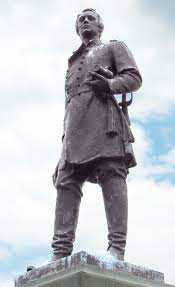
Statue of Francis Barlow at Gettysburg

Throughout July 1 the Union Army sent reinforcements north of Gettysburg to form a line and meet the also gradually expanding Confederate force. The defensive line, which had been holding up nicely, finally came undone when the German immigrants of the XI Corps panicked and fled, enabling the Confederates to unravel it and send the Unions running through town. The Germans, or “Dutch,” ran just like they did at Chancellorsville when Stonewall Jackson had marched into their flank. It was not cowardice that lost the first day of Gettysburg, however. It was in fact a tactical blunder on the part of General Francis Barlow, a divisional commander. Instead of connecting his left flank with Carl Schurz’s division, he advanced to the height of Blocher’s Knoll so the enemy could not use it. What resulted was an overextended salient which the Confederates were able to break through. The largely German XI Corps had no choice but to retreat with Confederates pouring into their right flank. Some critics also (more incorrectly) claimed that these men almost lost Cemetery Hill on July 2 by running again.

Thursday, July 21, 2022

Kurz & Allison Part V: The Summer of ’63

 Mid-1863 saw several battles and campaigns that put military momentum solidly with the Union. Many consider this the turning of the tide, though it can be argued that the Union  was once on the verge of winning in mid-1862 and the Confederacy actually made some comebacks in 1864.

Battle of Chancellorsville


After restoring morale and efficiency within the Army of the Potomac, General Joseph Hooker attempted a flanking movement across the Rappahannock against Lee’s Confederate forces. He actually placed the heavily outnumbered Lee in a tricky situation near Chancellorsville at the start of May 1863. On May 2 General “Stonewall” Jackson executed an incredible flank march that routed the Union right. Jackson was hit by friendly fire (he would actually die of pneumonia instead of his wounds) while Hooker suffered a concussion that affected his judgment. The next day the Confederates were able to drive the Federals back across the river. Despite accomplishing one of his most celebrated victories, Lee believed that he could not afford any more such bloody battles.

Kurz focuses on the events of May 2. He shows the Union troops withdrawing towards the background, where artillery covers their retreat. The centerpiece, however, is the wounded Jackson. It looks like he’s been hit by a lucky enemy bullet rather than friendly fire. All the Confederate soldiers are ahead of him attacking the Federals. Also, Jackson was hit at night while reconnoitering ahead of his lines, not during  the height of the daylight action. Obviously Kurz wanted to show the infamous shooting while still displaying a battle vista.

Battle of Champion Hills


This is the first of two lithographs covering the Vicksburg Campaign. After a string of failures to take the last Rebel bastion on the Mississippi River, General Ulysses S. Grant finally put together his magnum opus. With the help of the Navy he was able to quickly slip his army from north to south of Vicksburg and cross back over the Mississippi (into the state of the same name). What followed was a string of battles where Grant defeated disunified Confederate forces. Champion Hill (called Champion Hills for the lithograph) was one of the more crucial encounters. On May 16 Grant struck General Louis Pemberton’s main force at the considerable height of Champion Hill. The Federals first flanked and then smashed through the Confederate lines, taking the nearby crossroads. The battle forced Pemberton towards Vicksburg with no escape route, ensuring a siege.

I am not as acquainted with this battle so I might miss a couple inaccuracies or neat references to real locations and figures. The Confederates in the foreground are notably more diverse in their clothing, especially the prisoners. Those on the right in front of the formidable Champion Hill sport a battle flag with inverted colors for St. Andrew’s Cross and the stars. The mounted figure leading his men on with his hat is General John Logan, who got into the Confederates’ flank. Logan was a political general from Illinois who enjoyed more success than others of his kind, possibly because his aggression worked well with Grant and Sherman’s battle plans.

The Battle of Gettysburg

The bloodiest (and almost largest) battle on North American soil, Gettysburg occurred from July 1 to 3. Lee, looking for a quick blow to end the war, invaded the North for the second time. Through a series of mistakes and circumstances, the two sides blindly struck each other north of the crossroads town of Gettysburg, Pennsylvania. On the first day Confederates pushed the Federals south through the town. The Army of the Potomac, now under General George Meade, took the heights south of town and narrowly repulsed a series of attacks on the second day. The third day cemented the Confederate defeat when Lee’s major assault on the Union center turned into a bloodbath. This was the first and perhaps only massive tactical defeat for Lee.

As with most artists who choose one part of the battle, Kurz focuses on Pickett’s Charge, the ill-devised July 3 assault on Cemetery Ridge. This is definitely one of his more cluttered works and I have to say not as striking. Masses of men from both sides advance from the sides of the lithograph. A wrecked Union battery shows the work of the incredible pre-assault bombardment (which was actually ineffective thanks to untested ordnance). A clump of Confederate prisoners are escorted off while a thick line of men snakes over the stone wall. The fence along Emmitsburg Road can be made out behind a shell-struck group of Rebels. If the dying officer on horseback is supposed to be General Lewis Armistead, Kurz forgot he was on foot for the whole charge.

Siege of Vicksburg

The Siege of Vicksburg lasted from May 18 to July 4. Grant made several attempts to take the city by force, all of which failed. Bombardments, though terrifying to the civilians, also did not wear down Confederate resistance. It was starvation that finally forced the loss of the city. Pemberton was supposed to get relief from General Joseph Johnston to the east, but Johnston dallied. Relief attempts from the Trans-Mississippi came too late and ended in defeat anyways. On July 3 Pemberton opened up talks of surrender, which were finalized the following day. Combined with the defeat at Gettysburg, this was a disaster for the Confederacy, giving the Union unrestricted access along the Mississippi River.

This is one of the more placid works, though there is still some action. Shells burst among the entrenchments and Union gunboats patrol the Mississippi River. For once some of the soldiers are shown not fighting. Many are actually lounging about, in great contrast to all the activity on the left side of the lithograph. In the right foreground an officer directs Grant’s attention (to what we don’t know). A Confederate party carrying a white flag emerges from the trees. It could be a flag of surrender, but the tiny red cross in one corner indicates it may be something else.


Tuesday, March 8, 2022

8 Inaccuracies in the Movie Gettysburg (1993)

 Ted Turner’s Gettysburg is the 1993 film (with a successful mini-series performance on TNT) that got me interested in the Civil War. It’s my favorite Civil War movie period, even if technically there are better entries on the subject. While it will always hold a special place in my heart, I have noticed, through the observations of others and my own expanding knowledge of history that there are a few inaccuracies. Some are carried over from Michael Shaara’s Killer Angels, the historical novel on which the movie is based on. Others were mistakes or intentional cinematic choices on the part of the filmmakers. This is not a heavy criticism, as the inaccuracies are for the most part harmless and in a couple cases help make a better viewing experience. I will not list the soldiers’ well-fed and often older appearance, as the movie’s budget required the voluntary efforts of reenactors rather than meticulously selected extras or hired soldiers to fill out the battle scenes. Let’s start with a couple light ones.

#1. The 14th Brooklyn is at the Wrong Place

When General John Reynolds falls to a sharpshooter’s bullet, a regiment wearing red kepi hats and trousers stops to gather around him. Several units in the Army of the Potomac had colorful uniforms, but none were present for the first day’s battle around McPherson’s Ridge. The 14th Brooklyn, actually part of the 84th New York, was part of Reynold’s Corps, but fought at the Railroad Cut to the north. They were popularly known as the “red-legged devils” and were known to be Abolitionist in their politics. They were originally supposed to be off in the distance to show some scale to the battle scenes. Director Ron Maxwell, however, tired of shooting a sea of blue uniforms, decided to have them front and center for a big scene.

Saturday, February 12, 2022

The Battle of Hanover (June 30, 1863)

 On June 30, the eve of the Battle of Gettysburg, three brigades of cavalry under the famed General J.E.B. Stuart clashed with a division of Union counterparts under General Judson Kilpatrick at the town of Hanover, Pennsylvania. This was one of many cavalry clashes on the way to the fateful battle of Gettysburg, but is worth some study for two reasons.

1.      First, this battle came about as Stuart, separated from the main body of Robert E. Lee’s Army of Northern Virginia, tried to reconnect his three cavalry brigades. The Federals at Hanover stood in his way of getting to Gettysburg, where he thought he might find Lee. If he had plowed through Kilpatrick’s rear guard or been fortunate enough to arrive there after the Federals were gone, he would have gotten to Gettysburg at least on July 1, seriously altering the course of events.

2.     Secondly, it was the first battle where George Armstrong Custer, one of the most famous cavalrymen in US history, held field command. He had so far spent most of the war as a capable staff officer. This was his first serious test.


Friday, November 5, 2021

Ten American Civil War Era Films to Watch

In contrast to some more recent wars, the American Civil War, despite its prominence in historical literature and television documentaries, has not prompted a slew of high profile films. The war was a popular film subject in the silent era, understandable since it was in literal living memory at the dawn of the 20th Century. Afterwards, however, full-fledged Civil War films grew quite rare. The reason is that an accurate portrayal of events like the Battle of Antietam would require a lot of money and effort put into costuming, battle scenes, etc. This would not be an issue if there was a guaranteed audience. Many moviegoers have strong views on the war or little interest in historical dramas to start with, so spending tens of millions of dollars on a battle epic is a risky venture.

I make this a list of Civil War “Era” rather than Civil War films as my pool of selections is somewhat shallow. Numerous films tie into the war. Many, however, are home front dramas (adaptations of Little Women provide many examples). Still more are westerns, and these are either based on or inspired by Quantrill’s Raiders or use the war as a background for more typical genre staples like fighting Apaches or tales of personal vengeance. As with my list of ten World War II films to watch, I made my selections to cover various aspects of the Civil War Era rather than the actual top ten best movies. I will not include the two mini-series The Blue and the Gray and North and South. My super-quick summary is that the former has some cheesy production values but more relatable characters while the latter has much higher quality in costumes and battle scenes but much more over-the-top drama. I also will not list “relevant recommendations” but instead have a brief list of other films to check out with a quick summary/opinion.

Saturday, August 29, 2020

The Second Battle of Winchester: The Confederate Victory that Opened the Door to Gettysburg (book review)

Wittenberg, Eric J. and Scott L Mingus, Sr. The Second Battle of Winchester: The Confederate Victory that Opened the Door to Gettysburg. Savas Beatie, 2016.

Wittenberg and Mingus team up to reveal a battle that has been overlooked even by Civil War enthusiasts. The Second Battle of Winchester occurred on June 13-15, in Virginia’s bountiful Shenandoah Valley. In this event General Richard Ewell’s I Corps of the Confederate Army of Northern Virginia successfully entrapped over half of General Robert Milroy’s Union force at Winchester. The battle removed all potential opposition to General Robert E. Lee’s invasion route into the North. The battle has usually received scarce attention, a pit stop on the way to the much larger Battle of Gettysburg.

            Wittenberg and Mingus seek to argue that this battle had significant impact, though are careful not to over exaggerate. After his disastrous defeat, Milroy tried to clear his name by arguing that the battle delayed the Confederate forces and gave the Union Army of the Potomac time to concentrate and meet the enemy at Gettysburg. Citing a similar argument by a Confederate veteran who saw the battle as a serious delay, the authors agree that if not for the Battle of Winchester Gettysburg would very likely not have happened, at least as it did, but do not dare to say if the Confederates would have been the victors instead. The battle also raised alarm levels in the North and hopes in the South. People across American and even in Britain seriously viewed as the prelude to a successful Confederate invasion. The Union victory at Gettysburg soon washed away the hysteria and exultation respectively.

            Otherwise the book describes the background and details of the battle. For a small battle this is a lengthy book, which can be a good or bad thing depending on your personal preferences. The first chapter details the Union occupation of Winchester, which was rife with tensions between the occupiers and occupied. Milroy was involved in the theft of civilian property, making him particularly unpopular to residents of the Valley.  The authors further go into General Ewell, who headed the Confederate invasion. They restore some of his reputation, showing that he and his subordinates pulled off the battle spectacularly and any failed measure of success can be attributed to the unpredictability of war. Milroy, remembered as a bungler, also receives a (not full) revival of his reputation. While the authors agree that he could have conducted the battle better and likely should have just retreated before engaging, he was left to dry by his superiors, who failed to either send reinforcements or to firmly order a withdrawal.

          The battle itself is described in great detail, easier to do for a smaller engagement. The battle is described so vividly and through the eyes of so many men on the ground that it might be surprising to observe the light numbers of killed and wounded. I would recommend this book more to somebody already well versed in Civil War history, or perhaps to someone who wants to do a video or book project on the Gettysburg Campaign that pays more attention to the lead-up. One who is just getting into Civil War history might find it overwhelming to read such an in-depth work on a small battle which, despite the authors’ hard work, still has questionable impact on the overall war. Then again, small events often have great ramifications that are hard to see.

The book can be bought here.

Rating: Highly Recommend

Rating System

Must-Read: Definite read for history in general
Highly Recommend: Definite read within a certain subject
Recommend: Good for further information or into on a certain topic
Adequate: Useful if looking for further information certain topic
Pass: Awful, only useful for examining bad or ideologically-tainted history