Showing posts with label film. Show all posts

Tuesday, March 8, 2022

8 Inaccuracies in the Movie Gettysburg (1993)

 Ted Turner’s Gettysburg is the 1993 film (with a successful mini-series performance on TNT) that got me interested in the Civil War. It’s my favorite Civil War movie period, even if technically there are better entries on the subject. While it will always hold a special place in my heart, I have noticed, through the observations of others and my own expanding knowledge of history that there are a few inaccuracies. Some are carried over from Michael Shaara’s Killer Angels, the historical novel on which the movie is based on. Others were mistakes or intentional cinematic choices on the part of the filmmakers. This is not a heavy criticism, as the inaccuracies are for the most part harmless and in a couple cases help make a better viewing experience. I will not list the soldiers’ well-fed and often older appearance, as the movie’s budget required the voluntary efforts of reenactors rather than meticulously selected extras or hired soldiers to fill out the battle scenes. Let’s start with a couple light ones.

#1. The 14th Brooklyn is at the Wrong Place

When General John Reynolds falls to a sharpshooter’s bullet, a regiment wearing red kepi hats and trousers stops to gather around him. Several units in the Army of the Potomac had colorful uniforms, but none were present for the first day’s battle around McPherson’s Ridge. The 14th Brooklyn, actually part of the 84th New York, was part of Reynold’s Corps, but fought at the Railroad Cut to the north. They were popularly known as the “red-legged devils” and were known to be Abolitionist in their politics. They were originally supposed to be off in the distance to show some scale to the battle scenes. Director Ron Maxwell, however, tired of shooting a sea of blue uniforms, decided to have them front and center for a big scene.

Friday, November 5, 2021

Ten American Civil War Era Films to Watch

In contrast to some more recent wars, the American Civil War, despite its prominence in historical literature and television documentaries, has not prompted a slew of high profile films. The war was a popular film subject in the silent era, understandable since it was in literal living memory at the dawn of the 20th Century. Afterwards, however, full-fledged Civil War films grew quite rare. The reason is that an accurate portrayal of events like the Battle of Antietam would require a lot of money and effort put into costuming, battle scenes, etc. This would not be an issue if there was a guaranteed audience. Many moviegoers have strong views on the war or little interest in historical dramas to start with, so spending tens of millions of dollars on a battle epic is a risky venture.

I make this a list of Civil War “Era” rather than Civil War films as my pool of selections is somewhat shallow. Numerous films tie into the war. Many, however, are home front dramas (adaptations of Little Women provide many examples). Still more are westerns, and these are either based on or inspired by Quantrill’s Raiders or use the war as a background for more typical genre staples like fighting Apaches or tales of personal vengeance. As with my list of ten World War II films to watch, I made my selections to cover various aspects of the Civil War Era rather than the actual top ten best movies. I will not include the two mini-series The Blue and the Gray and North and South. My super-quick summary is that the former has some cheesy production values but more relatable characters while the latter has much higher quality in costumes and battle scenes but much more over-the-top drama. I also will not list “relevant recommendations” but instead have a brief list of other films to check out with a quick summary/opinion.

Friday, July 9, 2021

The New Mexico Campaign, 1861-1862 Part VII: Remembrance and Assessment


Remembrance & Historiography

At the end of the campaign Albert Peticolas, having just endured the horrid retreat from New Mexico, noted in his journal that “our operations out here will all be lost in history, when such great struggles are going on nearer home…”[1] The Civil War in the Southwest would indeed be considered a sideshow, though it would receive a few articles in Battles and Leaders of the Civil War. One of the writers, Brigadier-General Latham Anderson, attempted to argue the importance of the campaign. He wrote that if Sibley’s men had reached California, they would have doubtlessly created a strong presence in the state and created large implications for the Union war effort. With California’s coastline added to Confederate territory, the already strained Union blockade would have lost any effectiveness. However, such grand ramifications, even when expressed by a Civil War veteran and late 19th Century general, remain speculative as Sibley’s campaign was done in before it could ever get out of New Mexico.[2] Only one Confederate, Teel, provided an article in which he castigated Sibley. “He did not husband his resources, and was too prone to let the morrow take care of itself,” he wrote. Teel believed that if Baylor had been given command, “the result might have been different.”[3] There was some argument among the Union contributors over Canby’s leadership, but this failed to spark any great historical inquiry into the campaign.

Some veterans kept memories of the campaign more alive through unit histories or published speeches. Once these survivors had died off, the war for the Far West became a piece of trivia, unknown by many. It often did not garner a mention in general Civil War histories, including Bruce Catton’s centennial trilogy. This is not to say that historians totally forgot about it. Several books were published in the 50s and 60s. Sibley’s campaign was presented in Robert Lee Kerby’s The Confederate Invasion of New Mexico and Arizona (1958), Martin Hardwick Hall’s Sibley’s New Mexico Campaign (1960), and several other works. Hall’s account of the campaign was the expansion of a doctoral dissertation, fleshed out with a wealth of newly discovered sources. Arthur Wright’s The Civil War in the Southwest (1964), is actually oriented around the adventures of James Carleton’s California Column rather than Sibley’s battles with Canby and the Coloradans.

Monday, January 27, 2020

Ten World War II Films to Watch


No war has gotten more time on theater screens than World War II. With its all-encompassing nature, diverse cast of characters and battles, and for many relatively clearer tale of good against evil, it makes for a very attractive cinematic subject. Also, being so recent, there is still plenty of original gear to use from tanks to uniforms to guns. That certainly saves filmmakers the trouble of building replicas from scratch. With so many World War II films out there, I thought I’d make a list of ten great films. This is not a list of the top ten films, though I only chose ones I consider to be at the least very good. I have tried to make a list that covers various aspects from the Holocaust to partisan warfare to the Nazi hierarchy. If you want to learn some history through movies, than watch these ten.

Before starting the list I have to recommend HBO’s Band of Brothers and The Pacific. They’re mini-series, not movies, but they are must-see due to their accuracy. I should also note that I only include films based directly on real people or events, so no Saving Private Ryan or one of those special mission action films like Dirty Dozen.

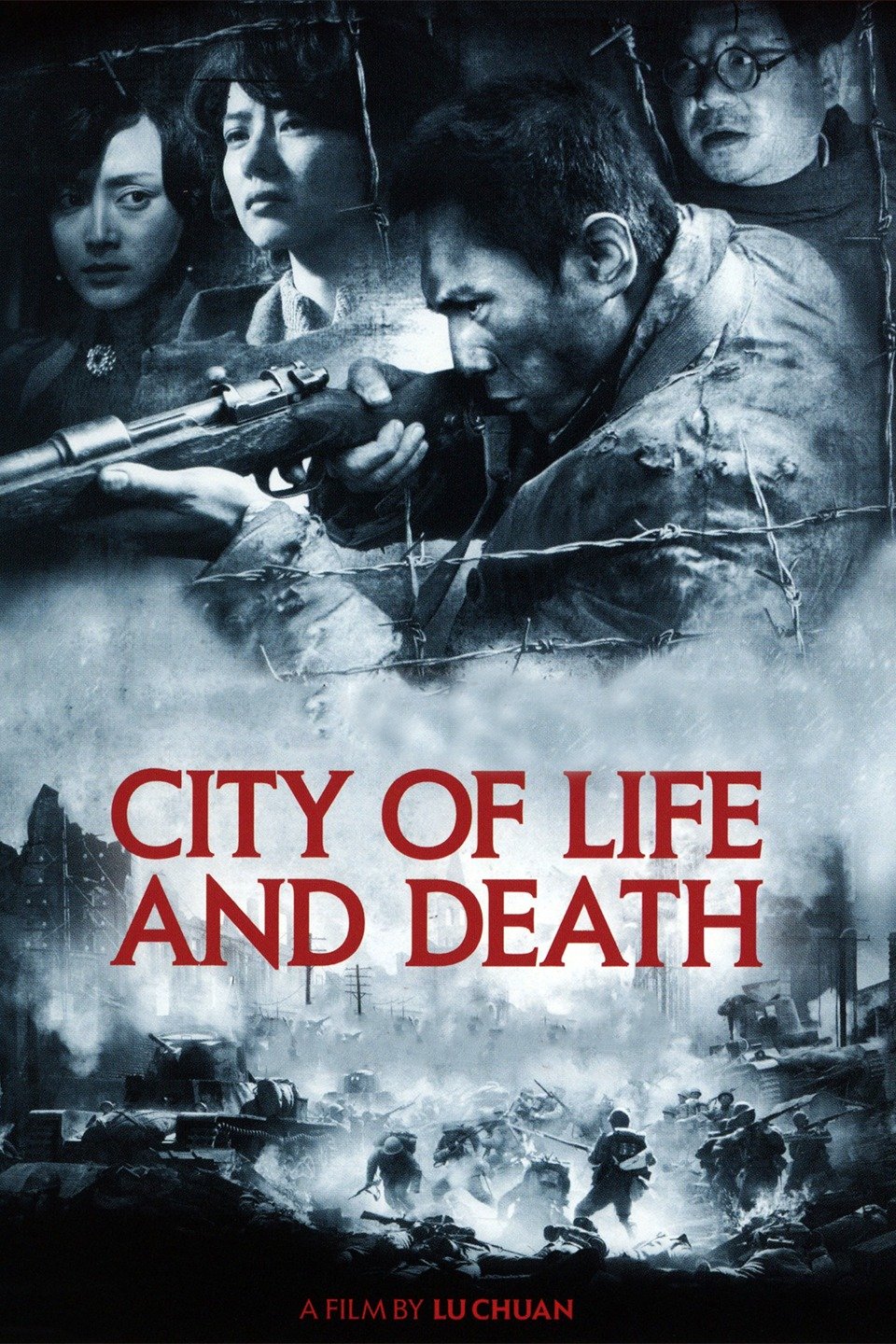
#1: City of Life and Death (2009)
Image result for city of life and death (2009)
The Sino-Japanese War does not get much play in Western film. There are plenty of Chinese movies on the subject, but they're hard to track down or rife with propaganda. One sub-topic that has lent itself well to film is the Rape of Nanking. In late 1937 the Japanese captured the Chinese capital of Nanking and embarked on one of the greatest streaks of terror in human history. At least tens of thousands of Chinese civilians were slaughtered, often with torturous methods. Almost as many women, ranging from young girls to the elderly, were raped, and many of these victims were killed afterwards. It’s a war crime matching and usually exceeding any incident in Hitler’s war with Russia.