Showing posts with label top ten. Show all posts

Friday, November 5, 2021

Ten American Civil War Era Films to Watch

In contrast to some more recent wars, the American Civil War, despite its prominence in historical literature and television documentaries, has not prompted a slew of high profile films. The war was a popular film subject in the silent era, understandable since it was in literal living memory at the dawn of the 20th Century. Afterwards, however, full-fledged Civil War films grew quite rare. The reason is that an accurate portrayal of events like the Battle of Antietam would require a lot of money and effort put into costuming, battle scenes, etc. This would not be an issue if there was a guaranteed audience. Many moviegoers have strong views on the war or little interest in historical dramas to start with, so spending tens of millions of dollars on a battle epic is a risky venture.

I make this a list of Civil War “Era” rather than Civil War films as my pool of selections is somewhat shallow. Numerous films tie into the war. Many, however, are home front dramas (adaptations of Little Women provide many examples). Still more are westerns, and these are either based on or inspired by Quantrill’s Raiders or use the war as a background for more typical genre staples like fighting Apaches or tales of personal vengeance. As with my list of ten World War II films to watch, I made my selections to cover various aspects of the Civil War Era rather than the actual top ten best movies. I will not include the two mini-series The Blue and the Gray and North and South. My super-quick summary is that the former has some cheesy production values but more relatable characters while the latter has much higher quality in costumes and battle scenes but much more over-the-top drama. I also will not list “relevant recommendations” but instead have a brief list of other films to check out with a quick summary/opinion.

Friday, October 23, 2020

Ten Battles from the Second Sino-Japanese War (1937-1945)


The Second Sino-Japanese War was one of the largest yet overlooked fronts of World War II. In this theatre of war Chiang Kai-Shek’s Nationalist government forces and Mao Tse-Tung’s Communists forged an uneasy alliance to stave off Japanese conquest. After victory was achieved, they quickly turned on each other. Though it was the first theatre of war to open up, predating Nazi Germany’s attack on Poland by two years, little has been written about it beyond the opening phases. Many sources and documents were destroyed by the upheaval of the continuing Chinese Civil War and then Mao’s Cultural Revolution. Information from Chinese or Taiwanese scholars are often heavily slanted in favor of the Communist or Nationalist causes or simply difficult to translate, while Japan’s presentation of its role in World War II is often purposefully hazy. Here are ten battles from an often ignored front of World War II, a couple fairly well-known and the others not so much.


#1: Shanghai (August 13 – November 26, 1937)


Shanghai was a major world economic center with thousands of foreign residents. It was therefore a natural target for Japanese military planners, who hoped to end the war with one swift blow. Chiang Kai-Shek also hoped to end the war soon. Thus both sides continuously funneled reinforcements into a desperate bid for quick victory. The battle itself largely took place within the city itself, resulting in furious and confusing building-to-building fighting. Ironically many Chinese units were led into battle by their German advisers (Germany was already under Nazi control and was turning towards an alliance with Japan).[1] The battle was a grueling stalemate, the Chinese using their numerical advantage to counter Japan’s advantage in aircraft and tanks. This changed in mid-November when the Japanese 10th Army arrived and made a major breakthrough with an amphibious operation.[2] The Chinese army was sent retreating towards Nanking. China had lost much of its industrial base as well as many of its best units. However, it displayed a newfound determination to resist decades of Japanese aggression. The Chinese lost over 250,000 out of 750,000 men while the Japanese lost about 40-60,000 out of 300,000.[3] The latter army would soon seize Nanking and commit one of the greatest atrocities of the 20th Century.

Monday, January 27, 2020

Ten World War II Films to Watch


No war has gotten more time on theater screens than World War II. With its all-encompassing nature, diverse cast of characters and battles, and for many relatively clearer tale of good against evil, it makes for a very attractive cinematic subject. Also, being so recent, there is still plenty of original gear to use from tanks to uniforms to guns. That certainly saves filmmakers the trouble of building replicas from scratch. With so many World War II films out there, I thought I’d make a list of ten great films. This is not a list of the top ten films, though I only chose ones I consider to be at the least very good. I have tried to make a list that covers various aspects from the Holocaust to partisan warfare to the Nazi hierarchy. If you want to learn some history through movies, than watch these ten.

Before starting the list I have to recommend HBO’s Band of Brothers and The Pacific. They’re mini-series, not movies, but they are must-see due to their accuracy. I should also note that I only include films based directly on real people or events, so no Saving Private Ryan or one of those special mission action films like Dirty Dozen.

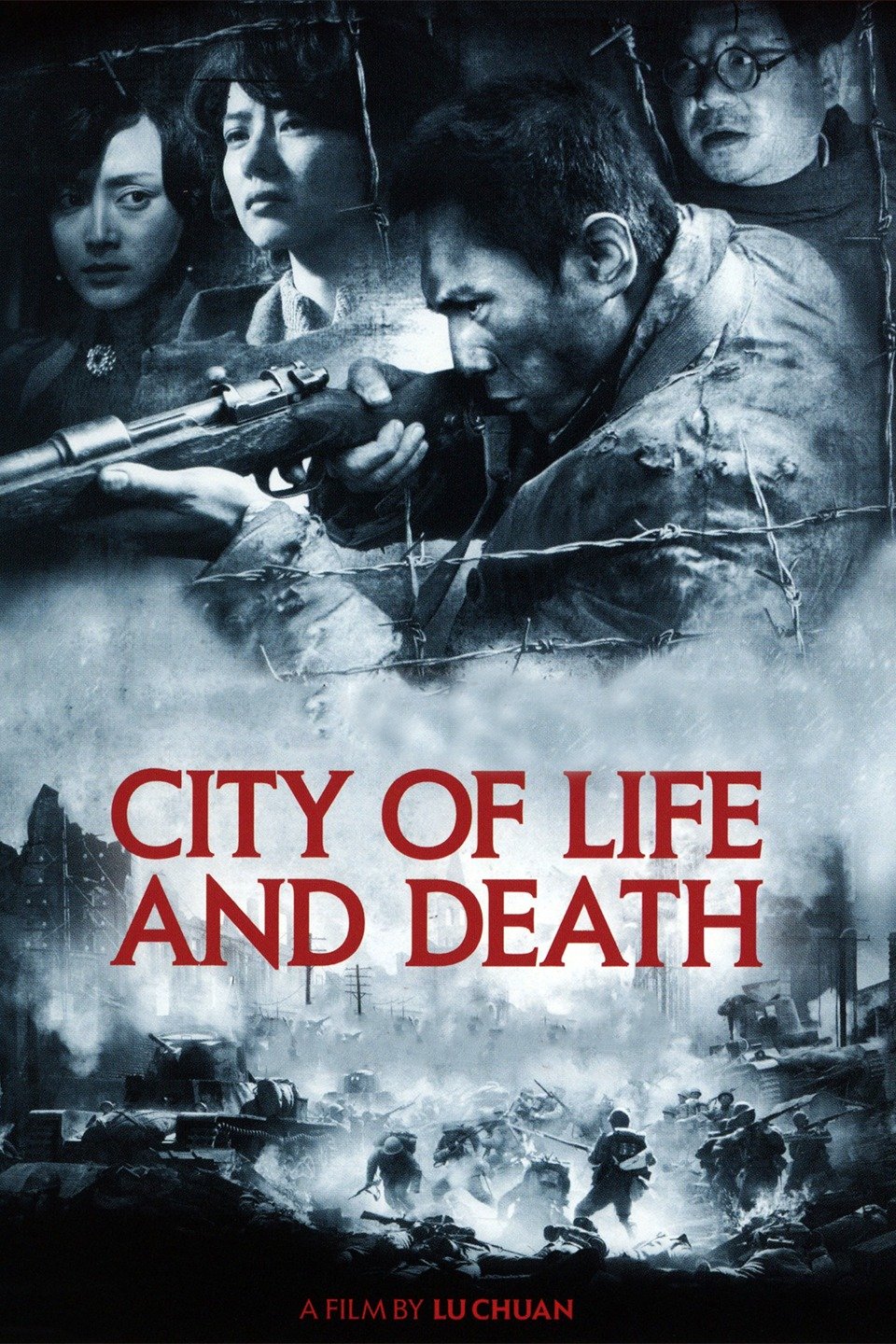
#1: City of Life and Death (2009)
Image result for city of life and death (2009)
The Sino-Japanese War does not get much play in Western film. There are plenty of Chinese movies on the subject, but they're hard to track down or rife with propaganda. One sub-topic that has lent itself well to film is the Rape of Nanking. In late 1937 the Japanese captured the Chinese capital of Nanking and embarked on one of the greatest streaks of terror in human history. At least tens of thousands of Chinese civilians were slaughtered, often with torturous methods. Almost as many women, ranging from young girls to the elderly, were raped, and many of these victims were killed afterwards. It’s a war crime matching and usually exceeding any incident in Hitler’s war with Russia.