Showing posts with label military history. Show all posts

Sunday, July 12, 2026

Americas 250th Birthday Cinemathon #35: Sergeant York (1941)


There’s a rich wealth of movies about World War I, but not many high-profiles ones that are actually American-centric. The majority of US citizens had no desire to get entangled in a large war between imperial European powers. Opinion slowly shifted over the course of the Great War, partly because of effective British propaganda (Anglo-American sentiment was growing strong thanks to shared language) and also because of German U-boat attacks on American shipping (they targeted ships carrying war material). The United States declared war in 1917, but it wasn’t until 1918 that it had an army ready to fight in Europe. The army suffered over 116,000 deaths, which seems light compared to the American Civil War and World War II, but was actually appalling when you consider how little time the Yanks actually spent on the front lines.

America’s reluctance to enter a global conflict and then it’s decision to join later, made the first war ripe material for interventionist propaganda come World War II. Sergeant York, based on the life of Medal of Honor winner Alvin York, plays into this, released in the middle of 1941 when America had not yet been attacked at Pearl Harbor. Thus this is actually a bit of interventionist propaganda, but regardless it’s a pretty good movie.

Actually, Sergeant York is not primarily a war movie thought the titular character’s military performance is the culmination of his character’s growth. Alvin York’s story resonated deeply with Americans because his background was linked to the earlier frontier figures of United States history. He grew up in the Appalachian hills of East Tennessee with little formal education and was an incredible shot with a rifle. Thus Americans had a mountain man, a tough yet humble hero, making his name in what was at the time a shocking revelation of modern war.

Friday, February 13, 2026

Americas 250th Birthday Cinemathon #10: Tripoli (1950)


 America’s first major war after gaining independence was not its rematch with Britain in 1812, or any prolonged war with a Native American people, but the Barbary Wars, a series of attempts to get North African states to cease piratical operations against American shipping. The states of Tunis, Algiers, and Tripoli (current day Libya), were Islamic Ottoman-supported states that, operating under the doctrine of Jihad, constantly attacked European shipping. The pirates would attack merchant and passenger vessels, seizing any goods and enslaving the crew and passengers. European nations would have to pay ransoms to free the slaves. The British government had willingly paid heavy sums to protect their merchant ships, which meant their economic competitors would suffer more seizures. Independent of Britain, the United States merchants were now fair game. After several humiliations, the US formed a proper navy and conducted the Barbary Wars, forcing the African states to stop.

This long paragraph provides background for Tripoli, a historical adventure film that, like many older Hollywood films, steers clear of the heavier elements of the story. We don’t hear about European prisoners being turned into slaves until they can be ransomed (the slave trade in this part of the world was actually quite massive, though by 1800 it had turned more into a ransom racket as the Islamic world was in decline) and there is nothing about the religious justification used by the state of Tripoli. Instead we get a typical, though exotic, adventure flick with a heavy infusion of ahistorical romance.

Sunday, February 8, 2026

Americas 250th Birthday Cinemathon #9: The Patriot (2000)


The last of my American Revolution movies is The Patriot, the “largest” film portraying the conflict and one of the more controversial. Its director, Roland Emmerich, is famously a German who fell in love with the United States (perhaps not unlike Prussian officer Baron von Steuben!), so this movie is right up his alley. The Patriot is a semi-fictionalized account of Francis Marion’s guerilla war in South Carolina. Marion had already been an officer in the Continental Army, but rose to fame as a guerilla leader when the British mounted its major southern campaign in 1780. His effective hit-and-run attacks on British and Loyalist forces earned him the moniker “The Swamp Fox.”

Earlier drafts presented a more accurate and less black-and-white picture of the fighting in the South, but Emmerich insisted that he be allowed to make changes for a more crowd-pleasing good vs. evil narrative. This explains why Francis Marion is renamed Benjamin Martin. The historical Marion and his men sometimes engaged in can be considered war crimes. Marion was also a slaveholder, and had orders from above to execute any black man found fighting for or aiding the British.

Sunday, February 1, 2026

Americas 250th Birthday Cinemathon #8: Benedict Arnold: A Question of Honor (2003)


Benedict Arnold is the Judas of America’s national history. One of the Continental Army’s best generals, he faced frustration as other generals and members of Congress took credit for his accomplishments or passed him over for promotion. After marrying into a Loyalist family and being accused of profiteering, he decided to work with the British and almost gave them the important location of West Point. Discovered, he escaped to join the British Army and would die much later in England, reviled by the United States and treated with contempt or indifference by most of the British.

Benedict Arnold: A Question of Honor was an A&E television film that sought to give Arnold (portrayed by Aidan Quinn) a sympathetic portrayal. The Movie is for the most part accurate, but almost everything just feels…off. One major culprit is the rushed narrative. A two to three hour film could have better fleshed our Arnold’s psychology so we actually feel something when he turns on his country. Of course, it would need better dialogue and some better casting choices as well. A&E was able to make low-budget historical films like The Crossing and Shackleton look great, but you can really feel the low budget with this one.

Wednesday, January 28, 2026

Americas 250th Birthday Cinemathon #7: John Paul Jones (1959)


John Paul Jones was the first of a string of big budget productions from Samuel Bronston. Bronston really wanted colorful spectacle on the big screen, but this came back to bite him when he produced two major bombs in the 60s. Surprisingly, his career wasn’t killed in the crib by John Paul Jones, which made one quarter of its budget back. It's not too hard to see why this movie wasn't a major hit with audiences.

John Paul Jones was the first major naval hero of the United States, scoring victories, taking daring ventures such as an actual raid on home British soil at Whitehaven, and, most famously, shutting down a surrender demand by shouting, “I have not yet begun to fight!” This energetic figure is poorly served by his biopic. The first problem is that it’s one of those “greatest hits” films in well under two hours. It’s hard to create a gripping character arc or build up suspense when you’re bouncing around between times and locations. The movie itself begins aboard a modern American war vessel, where an officer with a “golly gee” voice starts a narration of Jones’ life. From there we see him as a child in Scotland, a regular merchant captain, a Virginia planter, and finally a naval officer sparring with British ships, making amphibious raids, and rubbing elbows with major political figures.

The other problem is the performance of Robert Stack. Stack looks too bored to be such a thrilling character. Then again, he doesn’t have much character beats to work with. The film does threaten us with a love triangle between him, Patrick Henry, and governor’s daughter Dorothea Danders (for some reason they altered her historical name Dandridge), but it’s quietly put away as the governor is dead set against him courting his daughter anyways.

Tuesday, January 27, 2026

Americas 250th Birthday Cinemathon #6: The Crossing (2000)


When I was growing up, A&E, the Arts & Entertainment Channel, used to produce TV movies, many on historical events and figures.  These films were of course low budget, but many turned out quite good (Shackleton, starring Kenneth Branagh, is one I’d recommend). The Crossing, adapted from a Howard Fast novel, is about the famous crossing of the Delaware River, when General George Washington launched a surprise Christmas attack on a Hessian garrison at Trenton, New Jersey.

In 1776 Washington presided over a series of defeats in New York. By the time his army escaped into winter quarters, enlistments were almost up and morale was horrendous. Washington was desperate to do something to raise morale and also show that the fledgling American nation could win battles. He led an audacious night march in freezing weather, which included the crossing of the Delaware River. He strategically hit the Hessians (German soldiers hired by the British) just after they had partied for Christmas. The result was a clear, one-sided victory wherein the Americans suffered only a few wounded (though a couple died from the cold on the march) and the enemy about a hundred wounded and killed, with hundreds more taken prisoner.

Saturday, August 9, 2025

The Battle of Marianna (September 27, 1864)

 After the disastrous East Florida campaign of early 1864, which culminated in the bloodbath of Olustee, the Civil War in Florida went back to the status quo of raids and specifically for the Federals occupation duties. There was one raid in September, however, that managed to leave a mark on Floridian memory. This raid’s high point was the Battle of Marianna, occurring at a lightly populated yet important location for the Confederate war effort.


A Raiding War

Though spared the larger battles in most other theatres of the war, West Floridian defenders were not in good shape heading into what would be the last year of the war. One Major-General Sam Jones reported, “The health of the whole command in this department has been unusually bad this season. It is believed that it would have been much worse had it not been for the use of quinine as a prophylactic, for the sanitary condition of the troops improved materially after its issue.” While quinine alleviated the diseases endemic to hot and in many places swampy Florida, the men were still severely short of clothes, especially shoes. The requests of Jones and other officers for clothes and other valuable goods went unheeded.[1]

Making matters worse, they were almost at the complete mercy of the Union military, with only strategic disinterest keeping the rebel presence alive in the interior. Fanny Chapman, a resident of Marianna, later wrote that “No part of our coast from Pensacola to Apalachicola was protected, while every bay, bayou, and inlet was blockaded, and the Apalachicola River was open to Federal gunboats at any time.”[2] The commander of the Union Army in West Florida was about to exploit Confederate weakness.

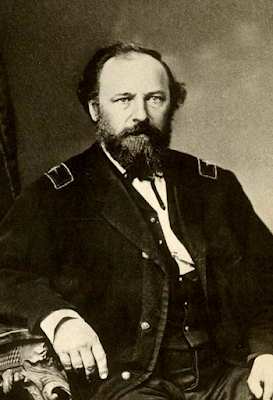
Alexander S. Asboth

Alexander Sandor Asboth was born in Hungary in 1811. He became an engineer for the government, then took part in the 1848 Hungarian revolt against Austrian rule. Like the other revolutions of that year, it failed and Asboth joined thousands of other European liberals in moving to America. Also like the other “Dutch”, he was a fervent supporter of the Union cause and joined the army in 1861.

Monday, July 7, 2025

The Battle of Santa Rosa Island (October 9, 1861)


Florida is not commonly associated with Civil War battles. I’ve already written on the Battle of Olustee, the largest and bloodiest confrontation in the state between Union and Confederate forces. While Florida is rightly seen as a sideshow theatre for most of the Civil War, it was considered important in 1861. One of the few remaining Federal outposts on southern soil in earl 1861 was Fort Pickens, situated on the western end of Santa Rosa Island in Pensacola Harbor. Secessionists had been trying to get the Federals to evacuate, and at times seriously considered an assault that would have made Pickens, not Sumter, the name associated with the start of the war.

Facing a heavy Federal blockade, the Confederates were keen to dislodge the Union presence on Santa Rosa Island. If they did so, they could construct more naval vessels and even send them out to challenge the blockade. In October of 1861 the Confederates launched their only major offensive action against the island, resulting in one of the few Floridian battles.


Across the Bay

General Braxton Bragg

As the war continued to shape up throughout 1861, Confederate president Jefferson Davis put his personal friend General Braxton Bragg in charge of Florida. Davis may have thought that this was a prime posting for his old army pal, as Fort Pickens remained a high-profile target. If it was taken, the harbor could be freed for both ship construction and naval operations. Bragg, however, was more concerned with his defensive obligations, expressing to his wife “This is a fearful responsibility.” He had to defend Florida with just 6,000 men. On a professional level he would much rather be in charge of the more important and critical New Orleans. Regardless of where he was, he would need success to advance his career friend, and he wrote to Davis for reinforcements. The president got him several regiments of additional men. Bragg’s numbers swelled to about 8,100 men, and these made up the Army of the Pensacola.[1]

Bragg’s main focus remained Pensacola and its access to the sea. The Pensacola Navy Yard was one of only three shipyards in the South. Its entrance was protected by three Forts. Two of them, McRae and Barrancas, were on the mainland. McRae was to the west of Santa Rosa Island. Barrancas was to the north, west of Warrington and the Naval Yard. All along the coast which ended in the Naval Yard, Bragg had placed batteries.  The third, Fort Pickens, was on Santa Rosa Island, situated near the west end of a long, then strip of land. Thanks to its separation from the main landmass, the island and fort were still held by Union troops.[2]

Saturday, December 30, 2023

The Last Battle: Palmito Ranch (May 12-13, 1865)


https://digital.utsa.edu/digital/collection/p9020coll008/id/3031/

For many, the end of the Civil War comes with the surrenders of Robert E. Lee’s and Joseph Johnston’s Confederate armies in April of 1865. Indeed, these events sealed the death of the Confederacy. However, the war did not properly end until early summer. There are two reasons for this. First of all, news traveled slower back then, even with the recent introductions of new railroads and the telegraph. Thus it took some time for Confederate forces further west to receive word that their war had been lost. Secondly, defiant elements in the Confederate government, President Jefferson Davis among them, refused to admit defeat. Since the head of government never confirmed an overall surrender, the still sizeable Confederate force west of the Mississippi was unsure as how to proceed. Some steeled themselves for a final stand, but most got the sense that things were indeed coming to an unfortunate conclusion. They were keen not to start any hostile actions which could prove to be unnecessary wastes of life. Yet such an unnecessary battle would occur.

On May 12-13 a Federal colonel who had managed not to see any action in his four years of service led three regiments along the Rio Grande, his purposes still up for debate. The result was the last proper battle between the forces of the Union and the Confederacy. It was light in hard casualties of killed and wounded, but lasted hours and generated controversy. This was the Battle of Palmito Ranch, fought in the most backwater theatre of the war.


The Border Front

Perhaps “backwater” would not be an entirely accurate term. The Rio Grande, as it does today, forms the boundary between Texas and Mexico. It was the one border of the Confederacy that the Union Navy could not blockade. If they dared send ships up the river, they would violate Mexico’s neutrality. This neutrality was only in regards to the American Civil War itself, for Mexico was undergoing its own civil war at the same time, one injected with a strong dose of foreign invasion as well. Eager to capitalize on the United States’ internal conflict, French Emperor Napoleon III sought to expand his nation’s global influence by intervening in Mexico’s always volatile politics. He backed the conservative Mexican faction, who wanted a monarchy, against the republican Juaristas.

Wednesday, January 4, 2023

McClellan’s War: The Failure of Moderation in the Struggle for the Union (Ethan S. Rafuse)


McClellan's War is Ethan Rafuse's 2005 attempt to truly decipher what Union General George B. McClellan, the first commander of the Army of the Potomac, was doing in the early third of the Civil War. For most of Civil War historiography, McClellan has been blamed for the Union's lack of success in Virginia. He was too egotistical in dealing with the President and other political leaders. He was needlessly cautious, displaying a mental handicap that prevented him from dealing several critical blows against Lee's Confederate Army. It does not help that McClellan was often in opposition to the deified Abraham Lincoln, even to the point of running against him for president. Historians and documentarians thus have depicted him as something of an arch-nemesis. Rafuse is one of several historians that have found this view of McClellan to be flawed, perhaps even cartoonish. In his 400 page tome he focuses primarily on McClellan's political and strategic beliefs and how they influenced his conduct of the war from 1861-1862.

The first quarter of the book fleshes out McClellan's background. He grew up in a Whig family. Many within the Whig political party, such as Henry Clay, emphasized compromise and careful rational thinking to solve political problems. When the Whig Party met its demise, McClellan shifted his views over to the Douglas Democrats. Like the Whigs, Stephen Douglas of Illinois stressed compromise to smooth over partisan differences and oppose extremism. He viewed both Secessionists and Republicans, especially Radical Republicans, as extremely dangerous. Though he sided with the Union, he was deeply concerned by the growing influence of abolitionist politics on war policy. He believed that this would stiffen Confederate resistance because of fears of a race war.

Sunday, December 4, 2022

Arkansas Summer Campaign Part III: Cotton Plant

 If they were to successfully make their way to Little Rock, General Samuel Curtis and his Army of the Southwest needed to hook up with Commander Augustus Kilty’s White River expedition and much needed supplies. The Confederates, assuming that Curtis was retreating instead of marching to meet Kilty, made a move to strike him. Little did they know they would be fighting a critical battle that would determine the course of the war in 1862 Arkansas.


Cotton Plant (or Hill's Plantation or Cache River)

Study map of Battle of Cotton Plant (Wikimedia)

On July 7 Curtis started his army towards Clarendon, the final leg of the march. To reach there he would first need to cross the Cache River. The Confederates had already made moves to hold the Cache River crossing. Brigadier-General Albert Rust led 5,000 men in the area. This force included Texas cavalry (six regiments) and Arkansan infantry. Rust ordered Colonel William Parsons to secure the crossing with the 12th and 16th Texas Cavalry (1,000 men in all). The 12th and 16th did not move up together and the former stopped 6 miles south of the crossing in order to wait for the other. By failing to secure the crossing with his 12th regiment, Parsons gave the Federals time to take it.[1] The area around the Cache River was heavily wooded, with plenty of swampland as well. As Federals and Confederates alike had to deal with branches, clouds of mosquitoes, and wet ground while a plethora of animals hooted, screeched, and flapped in the background. One Texan said it felt like a primeval world.[2]

Saturday, November 26, 2022

Arkansas Summer Campaign Part II: The White River Supply Run


Following the skirmish near Searcy, the Union Army of the Southwest would temporarily ground to a halt. With no good base of supplies, especially food, in northern Arkansas, Curtis would need the US Navy, patrolling most of the Mississippi River, to enable a successful drive on Little Rock. This following supply run would be quite the adventure, full of controversial actions from both sides.

Foraging War

His momentum halted after the Battle of Searcy Landing, Curtis ordered his generals Steele, Carr, and Osterhaus, to send out scouting and foraging expeditions to ascertain enemy strength and improve their supply situation. These foraging and scouting forays exposed the Army of the Southwest to a newly popular form of warfare in Arkansas: that of the guerilla. The history of the 9th Illinois Cavalry (in Steele’s Division), lists several such encounters. On one May day a private E.J. Jenkins “was foully murdered” by a party of bushwhackers, who had secreted themselves in a corn-crib at Cotton Plant. Another Illinoisan rushed ahead to avenge his partner, but was killed himself. Jenkins did not actually die immediately, but lingered on another day with five bullet wounds.[1]

Curtis and his generals discussed the recent surge of guerilla attacks. Osterhaus’ Third Division had gotten the worst of them, and the German-American was outraged by the treatment of Federal prisoners. The guerillas often beat and mutilated them before killing them. Curtis was similarly outraged and gave Osterhaus and his men permission to forego mercy. “…Such villains” are “not to be taken as prisoners.”[2]

Friday, November 18, 2022

Arkansas Summer Campaign Part 1: Operations around Searcy

Many historians like to write that people overlook the Trans-Mississippi theatre of the Civil War. While not as heavily covered as other parts of the war, there has actually been quite a bit written on it in the past 30 to 40 years. Scholarship has greatly expanded on Sibley’s New Mexico Campaign, Pea Ridge, Prairie Grove, and the battles in Indian Territory. Even when these books and articles began to pop up there had been a good amount on Wilson’s Creek and the Red River campaign. However, there are parts that are still rarely covered. This post gets into one of these parts.

The Arkansas summer campaign of 1862 is barely covered in histories. It was nestled between the Pea Ridge and Prairie Grove Campaigns, each centered around a large and significant battle. General Samuel Curtis’ drive to take Little Rock, the capital of Arkansas, mostly saw skirmishes and a handful of smaller, if intense, battles. It’s most prominent place in the histories is the last chapter of William Shea’s Pea Ridge: Civil War Campaign in the West. Because the campaign failed to seriously alter the course of the Civil War, it is understandably overlooked. However it in fact gave the Confederates another chance to turn the tide in the Trans-Mississippi and the small skirmishes and battles can still be interesting to study.


Curtis after Pea Ridge

On March 6-8, General Earl Van Dorn’s attempt to restore Confederate fortunes in Missouri came to an end at the Battle of Pea Ridge. After his defeat, Van Dorn was ordered to bring his army east of the Mississippi and help stop General Ulysses S. Grant’s momentum in Tennessee. The Union Army of the Southwest, the victor of Pea Ridge, was bloodied and far out on its supply line, so it withdrew back into Missouri. General Samuel Curtis, its commander, was enthused at having scored a victory. In his previous tenure in the Army he had failed to experience any combat. He had gotten a good deal of it and also come off with a major success. Feelings were high.

Monday, November 14, 2022

Kurz & Allison Part X: 1865

 The Confederacy died in 1865. The major battles of that year were all Union victories and mercifully shortened the war. Louis Kurz shows three of the significant actions which spelled out the death knell of the Confederacy. He also produced a fourth lithograph that to my knowledge has been absent from illustrated histories, likely because it was printed without color and does not encapsulate a battle.

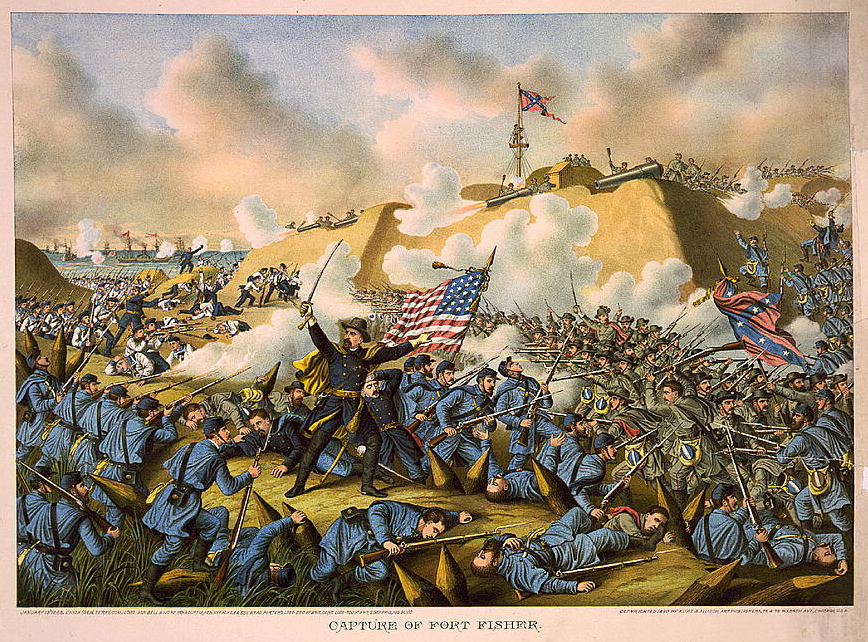
Capture of Fort Fisher

By 1865, the only Confederate port able to receive blockade runners and keep the Confederate forces, especially Lee's Army of Northern Virginia, alive was at Wilmington, North Carolina. The Union had held off on closing this port because the formidable Fort Fisher stood in the way. In early 1865 they finally made a move on it. The Navy under Admiral David Dixon Porter and a Corps of infantry under General Alfred Terry coordinated a controversially unchallenged landing on January 13 and an assault on January 15. Not properly supported by Confederate units miles away, the Confederate garrison under General George Whiting put up a stout defense, but eventually felt compelled to surrender. This cut the last major lifeline to Trans-Atlantic trade.

Thursday, October 27, 2022

Kurz & Allison Part X: Late 1864

 While General Grant and the Army of the Potomac were still stuck at Petersburg, the Union scored various victories in late 1864 that hastened the end of the Confederacy and ensured Abraham Lincoln's reelection as President. Naturally Union veteran Louis Kurz would feature some of these victories in his lithographs, two from Union General Phil Sheridan's Shenandoah Valley Campaign and two from Confederate John Bell Hood's ill-devised Tennessee offensive.

Battle of Opequan or Winchester

The title for this lithograph is somewhat misleading. Opequan is in fact spelled Opequon and this is the Third Battle of Winchester. To be fair to Kurz this is the largest Winchester battle of the war (Winchester changed hands at least 72 times). This was a major battle of the 1864 Shenandoah Valley Campaign. General Jubal Early and his Confederates had been running rampant, even approaching Washington D.C. itself. Newly arrived the aggressive Sheridan was determined to end his run. On September 19 he assailed the Confederates along Opequon Creek. The Federals broke through, only to be repulsed by canister fire. General Wesley Merrit's cavalry brigade got into the Confederate rear and after confused fighting Early withdrew to Fisher's Hill, the site of the next battle. This started a string of defeats for the Confederates in the Valley.

Wednesday, September 28, 2022

Kurz & Allison Part VIII: Overland Campaign

When Ulysses S. Grant became commander of all Federal forces at the start of 1864, he chose to personally oversee operations in Virginia, practically commanding the Army of the Potomac (General George Meade was still the technical commander, causing tension among the Union leadership). The ensuing campaign, which lasted through May and most of June, was a constant, hellish series of battles that saw high casualty rates among both Federals and Confederates.

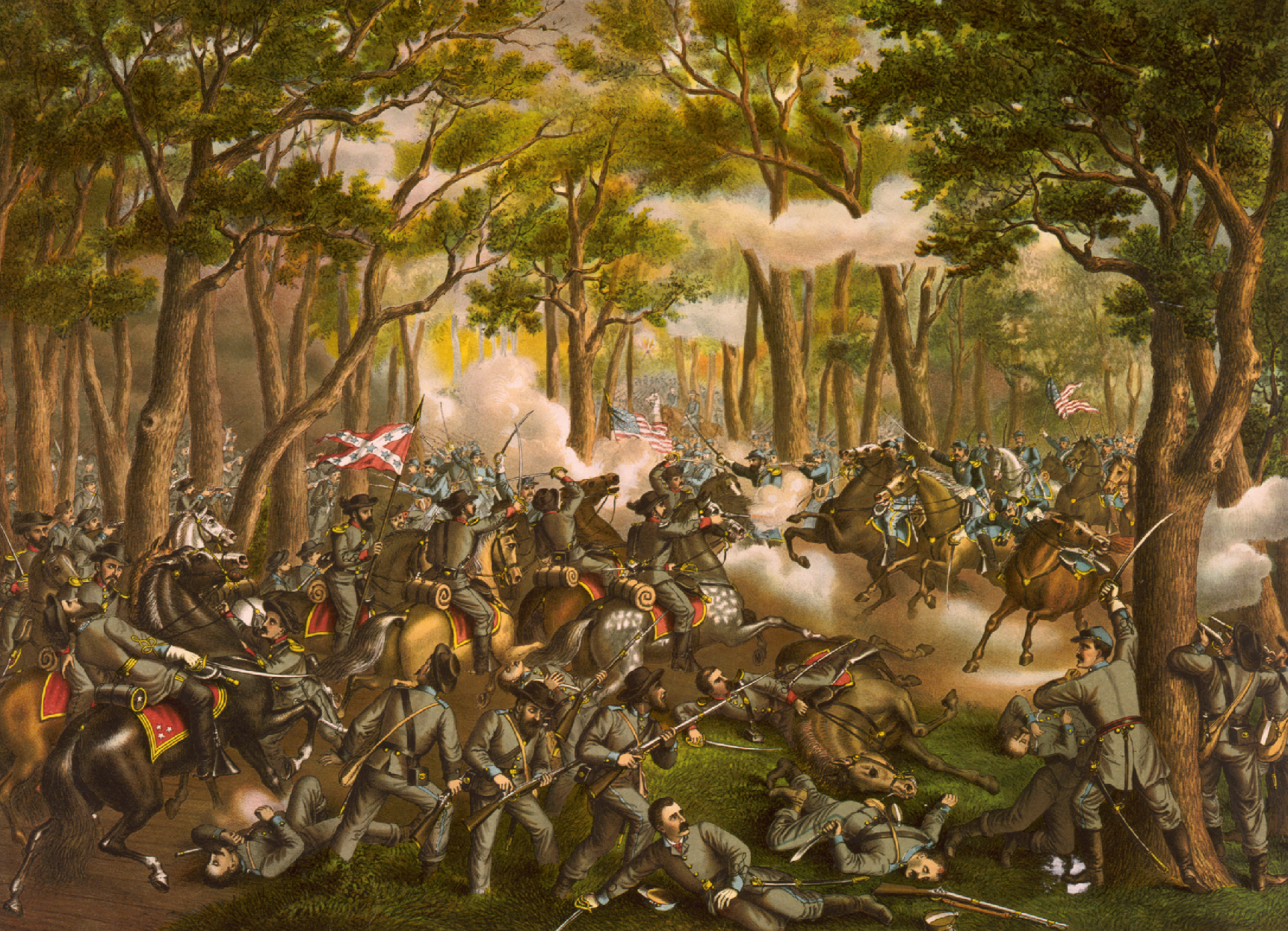
Battle of the Wilderness

The Wilderness is a wooded area. In fact it is part of the terrain over which the Battle of Chancellorsville was fought. Grant planned to get around Lee by quickly penetrating the dense forest. General Lee, however, blocked him on May 5 and a confusing and bloody battle ensued. It looked like the Federals would push through anyways on May 6, but reinforcements under General James Longstreet stopped them. The weather was dry and the vegetation caught on fire, burning many of the wounded alive. Tactically the Wilderness was a Confederate victory, but Grant simply marched his arm southeast and continued the campaign. His plan was to wear down Lee’s force through sheer attrition, as the North could much more easily replace its losses.

Monday, September 12, 2022

The Sack of Athens

On May 2, 1862, a brigade of Union soldiers descended on Athens, a small town and transportation hub in northern Alabama. What ensued was one of the earliest incidents of hard war against civilians, at a time when Union military policy stressed policies that would win ostensibly reluctant Secessionists back into the Union. The man at the center of this controversy was Colonel John Turchin, known by his detractors as the Mad Cossack.


The Mad Cossack


John Basil Turchin was the Americanized name of Ivan Vasilyevich Turchaninov. Turchaninov was born in the Province of the Don (the historical domain of the Cossacks) on January 30, 1822. His father was a major in the Imperial Russian Army and a lower-ranking noble. Ivan thus got into a good school, where he excelled. At the age of 14 he followed his father into the military, rising to colonel of the Imperial Guard in 1841. In 1849 he helped quash a revolution in Hungary. One historian notes that the soldiers’ large scale theft of food from the peasants was approved of as initiative by their commanders, as they were having trouble bringing their own stores of food up to the front. This might have played a role in Turchin’s mindset 30 years later.

During the Crimean War (1853-1856) he first earned a position on the personal staff of crown prince Alexander and then established defenses along the Finnish coast (Finland was at this time part of the Russian Empire). In 1856 Turchaninov married Nedezhda Lvova, an aristocrat’s daughter he had met in Poland. Around this time Turchaninov began to chafe at the military system in Russia. It promoted men through the ranks by nature of their birth and connections rather than merit. It also got in the way of much needed reforms. As a competent officer unable to rise any higher because of his comparatively modest background, Ivan was especially frustrated by the Russian Imperial order. He and Nedezhda, both liberal Russians, decided to move away from their homeland and its firm class system. They sought life in the United States. There the ex-soldier gained his Anglicized name while running a farm in New York. Once he and his wife learned English they moved to Chicago where he used his military experience to become an engineer.[1]

Wednesday, August 24, 2022

Kurz & Allison Part VII: Black Regiments

 Many white Union veterans had a deep respect for their black comrades in arms (check out Barbara Gannon’s The Won Cause, which shows how discrimination against blacks among veterans’ organizations was actually the exception rather than the rule). Louis Kurz was evidently among them, as he depicted black soldiers in a favorable light. I’ve already covered his use of helpful black civilians in the Monitor-Merrimac lithograph. This section contains three examples covering events from mid-1863 to early 1864.

Storming Fort Wagner

The summer of 1863 saw many attempts to capture the birthplace of secession: Charleston, South Carolina. In July General Quincy A. Gilmore sought to force Fort Sumter’s capture or surrender by seizing Morris Island and its Battery Wagner as a launching pad. The Federals landed on the island, but were not able to take the main objective. On July 18 the 54th Massachusetts, a regiment with Abolitionist white officers and mostly free northern blacks in the enlisted ranks, led a costly assault on Battery Wagner. The heavily outnumbered Confederates managed to repel the Union assault and only protracted siege warfare led to their abandonment of their post. Though a defeat, the battle proved to many that black soldiers could fight just as well as whites.

Thursday, August 11, 2022

Kurz & Allison Part VI: The Battles for Chattanooga

 Given that he operated out of Chicago, it was only natural that Kurz would focus much of his work on the glorious moments of the Army of the Cumberland (Illinoisans and other Midwesterners were heavily represented in this army) in the Chattanooga and Atlanta Campaigns. He extensively covered the former, producing a lithograph for three of the main actions outside the Tennessee transportation hub. First, we’ll look at the battle that turned General George Thomas into a national hero.

Battle of Chickamauga


In the summer of 1863 General William Rosecrans’ Army of the Cumberland skillfully maneuvered General Braxton Bragg’s Army of Tennessee out of Chattanooga. Though Rosecrans captured all his objectives in Tennessee, the War Department was annoyed that he had not brought the Confederates into a major battle so he could crush them. Feeling intense political pressure, Rosecrans marched into Georgia. James Longstreet’s Corps arrived from Virginia to bolster Bragg’s force and the Confederates attacked the Federals near the creek of Chickamauga. Thanks to a mix-up, the Federals accidentally opened a hole in their line. The Confederates exploited this and shattered their right flank. General Thomas was able to form a defensive line on Snodgrass Hill and hold off the enemy so the rest of the army could escape. For this he was called the “Rock of Chickamauga.” Occurring on September 19-20, it was the second bloodiest battle of the Civil War and the largest (albeit pyrrhic) Confederate victory in the western theatres.

Thursday, July 21, 2022

Kurz & Allison Part V: The Summer of ’63

 Mid-1863 saw several battles and campaigns that put military momentum solidly with the Union. Many consider this the turning of the tide, though it can be argued that the Union  was once on the verge of winning in mid-1862 and the Confederacy actually made some comebacks in 1864.

Battle of Chancellorsville


After restoring morale and efficiency within the Army of the Potomac, General Joseph Hooker attempted a flanking movement across the Rappahannock against Lee’s Confederate forces. He actually placed the heavily outnumbered Lee in a tricky situation near Chancellorsville at the start of May 1863. On May 2 General “Stonewall” Jackson executed an incredible flank march that routed the Union right. Jackson was hit by friendly fire (he would actually die of pneumonia instead of his wounds) while Hooker suffered a concussion that affected his judgment. The next day the Confederates were able to drive the Federals back across the river. Despite accomplishing one of his most celebrated victories, Lee believed that he could not afford any more such bloody battles.

Kurz focuses on the events of May 2. He shows the Union troops withdrawing towards the background, where artillery covers their retreat. The centerpiece, however, is the wounded Jackson. It looks like he’s been hit by a lucky enemy bullet rather than friendly fire. All the Confederate soldiers are ahead of him attacking the Federals. Also, Jackson was hit at night while reconnoitering ahead of his lines, not during  the height of the daylight action. Obviously Kurz wanted to show the infamous shooting while still displaying a battle vista.

Battle of Champion Hills


This is the first of two lithographs covering the Vicksburg Campaign. After a string of failures to take the last Rebel bastion on the Mississippi River, General Ulysses S. Grant finally put together his magnum opus. With the help of the Navy he was able to quickly slip his army from north to south of Vicksburg and cross back over the Mississippi (into the state of the same name). What followed was a string of battles where Grant defeated disunified Confederate forces. Champion Hill (called Champion Hills for the lithograph) was one of the more crucial encounters. On May 16 Grant struck General Louis Pemberton’s main force at the considerable height of Champion Hill. The Federals first flanked and then smashed through the Confederate lines, taking the nearby crossroads. The battle forced Pemberton towards Vicksburg with no escape route, ensuring a siege.

I am not as acquainted with this battle so I might miss a couple inaccuracies or neat references to real locations and figures. The Confederates in the foreground are notably more diverse in their clothing, especially the prisoners. Those on the right in front of the formidable Champion Hill sport a battle flag with inverted colors for St. Andrew’s Cross and the stars. The mounted figure leading his men on with his hat is General John Logan, who got into the Confederates’ flank. Logan was a political general from Illinois who enjoyed more success than others of his kind, possibly because his aggression worked well with Grant and Sherman’s battle plans.

The Battle of Gettysburg

The bloodiest (and almost largest) battle on North American soil, Gettysburg occurred from July 1 to 3. Lee, looking for a quick blow to end the war, invaded the North for the second time. Through a series of mistakes and circumstances, the two sides blindly struck each other north of the crossroads town of Gettysburg, Pennsylvania. On the first day Confederates pushed the Federals south through the town. The Army of the Potomac, now under General George Meade, took the heights south of town and narrowly repulsed a series of attacks on the second day. The third day cemented the Confederate defeat when Lee’s major assault on the Union center turned into a bloodbath. This was the first and perhaps only massive tactical defeat for Lee.

As with most artists who choose one part of the battle, Kurz focuses on Pickett’s Charge, the ill-devised July 3 assault on Cemetery Ridge. This is definitely one of his more cluttered works and I have to say not as striking. Masses of men from both sides advance from the sides of the lithograph. A wrecked Union battery shows the work of the incredible pre-assault bombardment (which was actually ineffective thanks to untested ordnance). A clump of Confederate prisoners are escorted off while a thick line of men snakes over the stone wall. The fence along Emmitsburg Road can be made out behind a shell-struck group of Rebels. If the dying officer on horseback is supposed to be General Lewis Armistead, Kurz forgot he was on foot for the whole charge.

Siege of Vicksburg

The Siege of Vicksburg lasted from May 18 to July 4. Grant made several attempts to take the city by force, all of which failed. Bombardments, though terrifying to the civilians, also did not wear down Confederate resistance. It was starvation that finally forced the loss of the city. Pemberton was supposed to get relief from General Joseph Johnston to the east, but Johnston dallied. Relief attempts from the Trans-Mississippi came too late and ended in defeat anyways. On July 3 Pemberton opened up talks of surrender, which were finalized the following day. Combined with the defeat at Gettysburg, this was a disaster for the Confederacy, giving the Union unrestricted access along the Mississippi River.

This is one of the more placid works, though there is still some action. Shells burst among the entrenchments and Union gunboats patrol the Mississippi River. For once some of the soldiers are shown not fighting. Many are actually lounging about, in great contrast to all the activity on the left side of the lithograph. In the right foreground an officer directs Grant’s attention (to what we don’t know). A Confederate party carrying a white flag emerges from the trees. It could be a flag of surrender, but the tiny red cross in one corner indicates it may be something else.