Showing posts with label war crimes. Show all posts

Monday, September 12, 2022

The Sack of Athens

On May 2, 1862, a brigade of Union soldiers descended on Athens, a small town and transportation hub in northern Alabama. What ensued was one of the earliest incidents of hard war against civilians, at a time when Union military policy stressed policies that would win ostensibly reluctant Secessionists back into the Union. The man at the center of this controversy was Colonel John Turchin, known by his detractors as the Mad Cossack.


The Mad Cossack
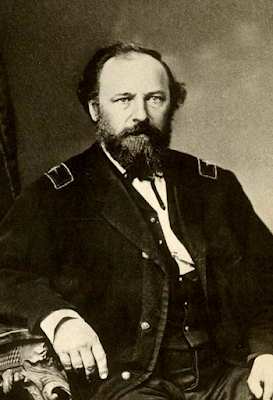

John Basil Turchin was the Americanized name of Ivan Vasilyevich Turchaninov. Turchaninov was born in the Province of the Don (the historical domain of the Cossacks) on January 30, 1822. His father was a major in the Imperial Russian Army and a lower-ranking noble. Ivan thus got into a good school, where he excelled. At the age of 14 he followed his father into the military, rising to colonel of the Imperial Guard in 1841. In 1849 he helped quash a revolution in Hungary. One historian notes that the soldiers’ large scale theft of food from the peasants was approved of as initiative by their commanders, as they were having trouble bringing their own stores of food up to the front. This might have played a role in Turchin’s mindset 30 years later.

During the Crimean War (1853-1856) he first earned a position on the personal staff of crown prince Alexander and then established defenses along the Finnish coast (Finland was at this time part of the Russian Empire). In 1856 Turchaninov married Nedezhda Lvova, an aristocrat’s daughter he had met in Poland. Around this time Turchaninov began to chafe at the military system in Russia. It promoted men through the ranks by nature of their birth and connections rather than merit. It also got in the way of much needed reforms. As a competent officer unable to rise any higher because of his comparatively modest background, Ivan was especially frustrated by the Russian Imperial order. He and Nedezhda, both liberal Russians, decided to move away from their homeland and its firm class system. They sought life in the United States. There the ex-soldier gained his Anglicized name while running a farm in New York. Once he and his wife learned English they moved to Chicago where he used his military experience to become an engineer.[1]

Tuesday, July 5, 2022

The Scalpings at Pea Ridge


The involvement of American Indians in the Civil War is a subject that has gradually gotten more attention in recent years. One incident with them, however, has long had a place in the American consciousness, albeit an incident reduced to an amusing or exotic anecdote to a lesser-known major battle in the West. The Battle of Pea Ridge, fought from March 7-8, was the largest battle west of the Mississippi River and also the largest to involve Indian units. Nearly 900 Cherokee, Creek, Choctaw, and Chickasaw Indians marched out of Indian Territory (present-day Oklahoma) to fight alongside Confederate units. After the Battle of Pea Ridge these Indian troops became the center of a controversy: the mutilation and scalping of killed and wounded Federal soldiers.

Historians have identified the culprits of these mutilations as the two Cherokee Regiments, the 1st Cherokee Mounted Rifles under Colonel John Drew and the 2nd Cherokee Mounted Rifles under Colonel Stand Watie. To understand why these Indians joined ranks with the Confederates, one would have to go back decades to the removal of Cherokees from their land in northwestern Georgia. The controversial treaties and resultant Trail of Tears towards the designated Indian Territory created antagonistic political divisions within the Cherokee Nation. On one side was Stand Watie and the Southern Rights Party. The Southern Rights Party consisted mostly of mixed-blood Cherokees who supported black slavery (which was practiced in the Cherokee Nation). With ties to white southern families and wealthier social status, they held significant political influence and were naturally inclined to pitch in with the Confederacy. On the other side was the National or Pin Party. Its members were more likely to be full-blooded Cherokees and more hostile to the idea of slavery. Ironically Stand Watie, the most prominent member of the Southern Rights Party, was three-quarters Cherokee while President John Ross, who relied on the support of the Pins and opposed an alliance with the Confederacy, was mostly white and a slaveholder himself. These two factions had in the past engaged in vicious blood feuds within Indian Territory. Wishing to end the fractious bloodshed and preserve his people, John Ross was able to soothe tensions with a general amnesty.[1] The divisions remained, however, and the Southern Rights Party eventually maneuvered the Cherokee Nation into the Confederate camp.