Showing posts with label 1864. Show all posts

Friday, January 13, 2023

Emancipation, the Union Army, and the Reelection of Abraham Lincoln (Jonathan W. White)


In Emancipation, the Union Army, and the Reelection of Abraham Lincoln, Jonathan White presents a more cynical but probably more realistic take on the Union Army in regards to the motivations of its soldiers. He challenges the popular historical consensus that the overwhelming army vote for Lincoln in the 1864 election reflected solidarity with Republican war aims of emancipation. While he directly addresses James McPherson’s works, which trumpeted the army as a force of emancipation, he also criticizes Chandra Manning’s What This Cruel War Was Over, and in doing so challenges her thesis as well. In her book Manning claimed that by looking at hundreds of Union and Confederate letters, the soldiers obviously fought for the issue of slavery. As regards the Federals, she believes they for the most part put Unionism I the background in favor of destroying slavery. White believes that she and other historians inferred too much from a considerable, yet still fractionally small pool of letters and diaries. I add that they also failed to take differing ethnic and regional backgrounds to account (for example, a soldier from southern Illinois would not be as inclined towards abolitionism as a Massachusetts man or radical German immigrant). Furthermore, he believes that soldiers’ views change back and forth in response to events. Historians can fall into the trap of taking a few diaries and letters and making them representative of the whole army. He avoids being representative himself, stating that he only wishes to flesh out those who did not vote against Lincoln and not make any monolithic claims.

He argues several general facts that challenge the popular narrative. Using voting statistics, he shows that 20% of soldiers eligible to vote chose not to do so, showing either disinterest or disgust with both parties. Many who voted for Lincoln did so because they did not approve of the Democrats’ anti-war platform and just wanted to win the war. Finally, in the age of public ballots, there was an atmosphere of intimidation that dissuaded Democrat votes. Some Republican officers rigged pro-emancipation regimental resolutions to appear unanimously in favor. Soldiers who wanted to vote for McClellan could be stopped out of fear of riling up their comrades and being accused of disloyalty. Officers could have their careers stalled or destroyed if they expressed too much criticism of abolitionism.

Through his work White concludes a common historiographical trend. Often there is a prevailing view of a historical event that stays entrenched for decades. Then a revisionist makes a stark counter-argument that becomes the predominant view, only later on for a third “neo-revisionist” work to argue a middle ground. For a long time the Union soldier was presented for fighting primarily for preservation of his republic. Then it became emancipation. White shows that “for many northern soldiers, restoring the Union was the only true goal of the war from beginning to end.” Though his lack of time on it may not reveal it, he argues that many soldiers indeed came to see emancipation as the higher cause, but perhaps just as many prioritized preserving the Union without any concern for blacks. He argues that the Union Army was an army of emancipation not from some popular “bottom-up” movement by the soldiers, but from a top-down implementation of policies by Lincoln, the War Department, and then the generals and other officers.

White’s book does a good job of providing a more nuanced view of the Union army and showing that there was not a strong pro-emancipation majority, but there are a couple flaws. White makes the same mistake as Manning in not differentiating the different types of ethnicities and regions making up the armies. In reading this book I noticed that the soldiers with the strongest anti-emancipation views came from such states as Illinois and Ohio. General Sherman’s 1864 army, which was made up of westerners, refused to accept any black soldiers. Westerners had stronger economic ties with the South, and may have shared more of their racial views as a result. My second issue is that some of the officers and soldiers that were dismissed for disloyalty were directing some very bold criticisms and insults towards Lincoln and abolition. White never suggests that they might have twisted the stories behind their comments when presenting them in court. A pillar of the United States is free speech but one wonders if such blatant attacks on war aims and the commander-in-chief would have been accepted or still are.

Regardless this is a great book from the recent Dark Turn in Civil War historiography. While not pleasant, it is essential for White and others to challenge some of the comforting narratives. White also better accounts for the fact that history is made up of individuals, not collectives. While group pressure can shape an individual, he, especially an American one, is likely to have some degree of difference in views. Federals soldiers’ views on emancipation varied widely from outright abolitionism to pragmatic emancipation to complete disinterest to even anti-emancipation.

The book can be bought here. It's price has gone down significantly since I had to get it for my Master's course.

Rating: Highly Recommend

Rating System

Must-Read: Definite read for history in general

Highly Recommend: Definite read within a certain subject

Recommend: Good for further information or info on a certain topic

Adequate: Useful if looking for further information certain topic

Pass: Awful, only useful for examining bad or ideologically-tainted history

Wednesday, September 28, 2022

Kurz & Allison Part VIII: Overland Campaign

When Ulysses S. Grant became commander of all Federal forces at the start of 1864, he chose to personally oversee operations in Virginia, practically commanding the Army of the Potomac (General George Meade was still the technical commander, causing tension among the Union leadership). The ensuing campaign, which lasted through May and most of June, was a constant, hellish series of battles that saw high casualty rates among both Federals and Confederates.

Battle of the Wilderness

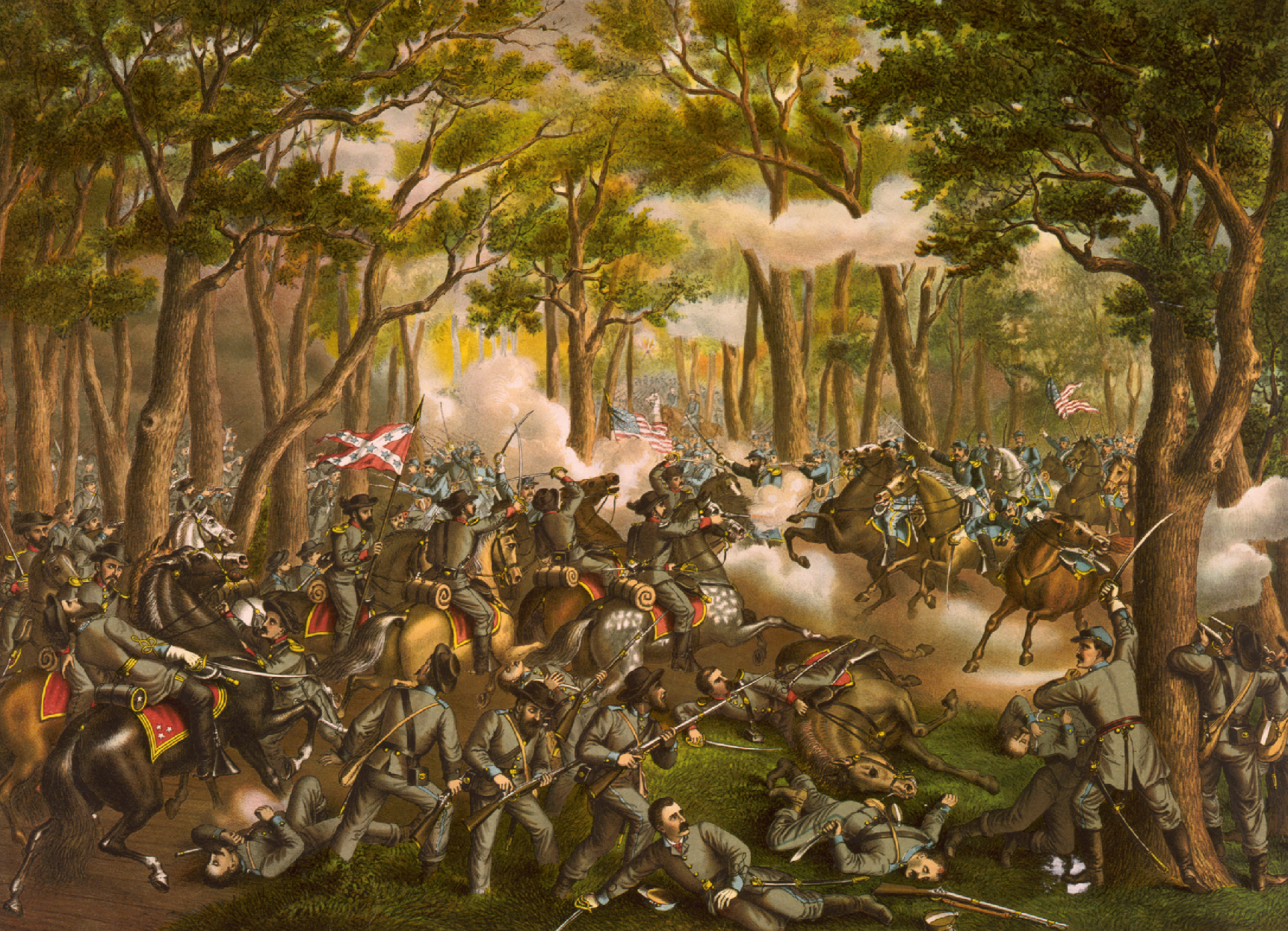
The Wilderness is a wooded area. In fact it is part of the terrain over which the Battle of Chancellorsville was fought. Grant planned to get around Lee by quickly penetrating the dense forest. General Lee, however, blocked him on May 5 and a confusing and bloody battle ensued. It looked like the Federals would push through anyways on May 6, but reinforcements under General James Longstreet stopped them. The weather was dry and the vegetation caught on fire, burning many of the wounded alive. Tactically the Wilderness was a Confederate victory, but Grant simply marched his arm southeast and continued the campaign. His plan was to wear down Lee’s force through sheer attrition, as the North could much more easily replace its losses.

Thursday, July 7, 2022

The Florida Expedition Part IV: The Death of the Florida Expedition


The Retreat

Colonel Barton claimed that his men had “not a single round of ammunition remaining.”[1] The artillery was in desperate straits as well. Langdon was down to 7 unwounded artillerists to draw his remaining guns off. Langdon ran for Seymour. All about him the firing was so intense that men were “being struck every instant.” Reaching his commander, he asked for men to help draw back the guns, as the caissons were far in the rear. There were no men to spare.[2]

Seymour tried to inspire his men to further defense. To instill caution in the enemy and slow them down, he suggested that the men give out loud cheers to give the impression that they were not so vulnerable. Captain Dana was about to order the cheers when a limping soldier passed by. Overhearing what the commander wanted, he issued a “hurrah for gen. Seymour and with the last word a stream of blood spurted from his mouth and he fell on his face dead.”[3]

The 54th Massachusetts had refused the initial order to retreat as it came from the unpopular James Montgomery. Colonel Hallowell intervened and gave the order himself. This time they complied. They enacted Seymour’s cheering plan. The black troops gave nine shouts of victory, then in an act of audacious defiance about-faced and marched away from the Confederates at a regular pace. Every couple hundred yards they turned and delivered a volley. One staff officer of Seymour’s liked to believe that the cheering strategy gave the enemy doubts and produced the lack of a strong pursuit, but in reality darkness and exhaustion affected the enemy infantry.[4] Captain Robert Newell had a more chaotic take on the retreat. “There were a number of stragglers on my right and left, who had rushed forward & been fighting on their own account, several of these were hit, and I shall never forget the cry of agony of one poor fellow who was hurrying to catch up to the rest & fell forward on his hands & knees disabled, for the men expected no mercy if taken remembering Fort Wagner, & made desperate exertions to get away.”[5]

Friday, July 1, 2022

The Florida Expedition Part III: The Battle of Olustee


Hawley vs. Colquitt

Early in the afternoon, 4 miles east of Olustee, the 40th Massachusetts Mounted Infantry met Confederate horsemen from the 2nd Florida and 4th Georgia Cavalry. The Confederate riders fell back, the Federals in pursuit.[1] Corporal William Penniman of the 4th Georgia took credit for drawing the first shots of the battle.  He was with Colonel Caraway Smith on top of a railroad embankment. Smith was looking one way with his field glasses, Penniman another. Penniman saw Seymour’s force and directed Smith’s attention to it. Smith, noticing the presence of black regiments, said, “It’s the Yankees sure enough and they seem to be niggers.” Federal skirmishers came within 300 yards and discharged “quite a volley.” The two Confederates mounted their horses and escaped.[2]

According to the history of the 1st Massachusetts Cavalry (a battalion, as readers might recall, that was assigned to the Mounted Infantry to serve as an experienced core), they reported back to the rest of the army that there were at least three Confederate regiments. Captain Elder of the Horse Artillery came up and said but could only see “just one man.” The Confederates, per Finegan’s plan, had withdrawn, the Federals unaware of how large the opposing force was.[3] Elder’s Horse Artillery advanced and with the 7th Connecticut established a firing line of skirmishers. Confederate cavalry would show themselves and then draw back, “as though inviting us to charge after them.”[4]

Saturday, June 25, 2022

The Florida Expedition Part II: Marching through Florida

 Camp Finegan

Once enough of his army had landed, Seymour led a force out of Jacksonville on February 8. Gus Henry’s Mounted Infantry, the only mounted force, would of course be the advance guard. Those in the 54th Massachusetts, who had been happy to leave fatigue duties at Charleston, were disappointed to learn that they would be staying behind on garrison duty for the moment. They entertained themselves by making a lot of noise in an attempt to make their regiment look larger to any Confederate partisans in the area. They were also pleased to find the civilians getting much friendlier than they had been during the landing.[1]

Seymour’s first target was Camp Finegan, the largest concentration of Confederate forces at that moment. The Rebels had destroyed all the bridges, so the Federals forded the stream instead. The mounted men led the way, surprising and capturing six pickets. In 10 minutes they were nearly upon the camp. Colonel Henry used a local guide, Mr. Alsop, to bypass the camp and strike an artillery camp at Pickett’s Station.[2]

Colonel Guy Henry. His 40th
Massachusetts Infantry was
constantly at the forefront of
the Florida Expedition.

The Confederates in the artillery camp, under Captain Joseph Dunham, were unaware of the danger. Outside, Henry formed his men for an assault, nearly surrounding the target, then said, “If ever you yell in your lives, boys, yell now!” The horsemen shouted to the calls of bugles. It was past 11 PM and most of the Confederates were already sleeping. A sergeant awakened Dunham, shouting, “Save yourselves if you can; the enemy is right upon you!” The captain yelled at everybody to grab horses, mules, or carriages, and flee to Baldwin. The Union riders entered the camp firing “their carbines and slashing with their swords shouting surrender you Rebel sons of bitches.” A Major Stevens gunned for a telegraph operator. An train was expected to arrive soon and the telegraph operator was determined to warn it away. “Major Stevens walked into the room and seized the fellow by the throat as he was on the point of sending another message. In a few minutes his instrument was knocked to pieces and the wire cut.” The Massachusetts riders quickly captured many Confederates, along with a few pieces of artillery. Much of the camp’s men escaped through the one opening, a system of swamps.[3] Henry’s men advanced further to Baldwin, driving off more Rebels and capturing more goods.[4]

Monday, June 20, 2022

The Florida Expedition Part I: The Start of the Campaign for Florida


People sometimes ask me why there was little fighting in Florida during the Civil War. The state noticeably juts out into the Caribbean and looks highly invasion prone. Narrow from east to west, one successful offensive could slice off a large chunk of the Confederacy. The truth is that until well into the 20
th Century Florida was a largely undeveloped state full of swamps and other wild terrain. Most of the important population centers were in the north. There was thus little strategic incentive for the Union forces to invade, and a simple blockade of its few ports was far less cost-intensive. That changed at the onset of 1864, when a mix of military, economic, and political factors suddenly drew the attention of Abraham Lincoln’s administration as well as the military Department of the South. The sole major campaign in Florida would climax in the Battle of Olustee, a Confederate victory that is often emphasized more as a Federal blunder. Historians usually portray the Florida Expedition as a wasteful sideshow akin to the Red River Campaign just about to start on the other side of the Confederacy. A few historians have attempted to argue that a Union success could have actually shortened the war. This series will attempt to see which side holds more weight.


Florida Before 1864

The American Civil War almost began months earlier in Florida. In late 1860 exuberant Secessionists planned an assault on a weakened Fort Pickens on Santa Rosa Island, in Pensacola Harbor (the westernmost point of the state). However politicians intervened, believing this would paint the Confederates as the instigator of hostilities and drum up war support in the North. This fear was still fulfilled when South Carolinians fired on Fort Sumter in Charleston Harbor.[1] Almost immediately the war hit Florida hard. Its inhabitants were heavily dependent on ships to export its produced goods and import what they did not make themselves. The absence of Northern trade vessels as well as the blockade led to the shutdown of businesses and shops alongside rising prices.[2]