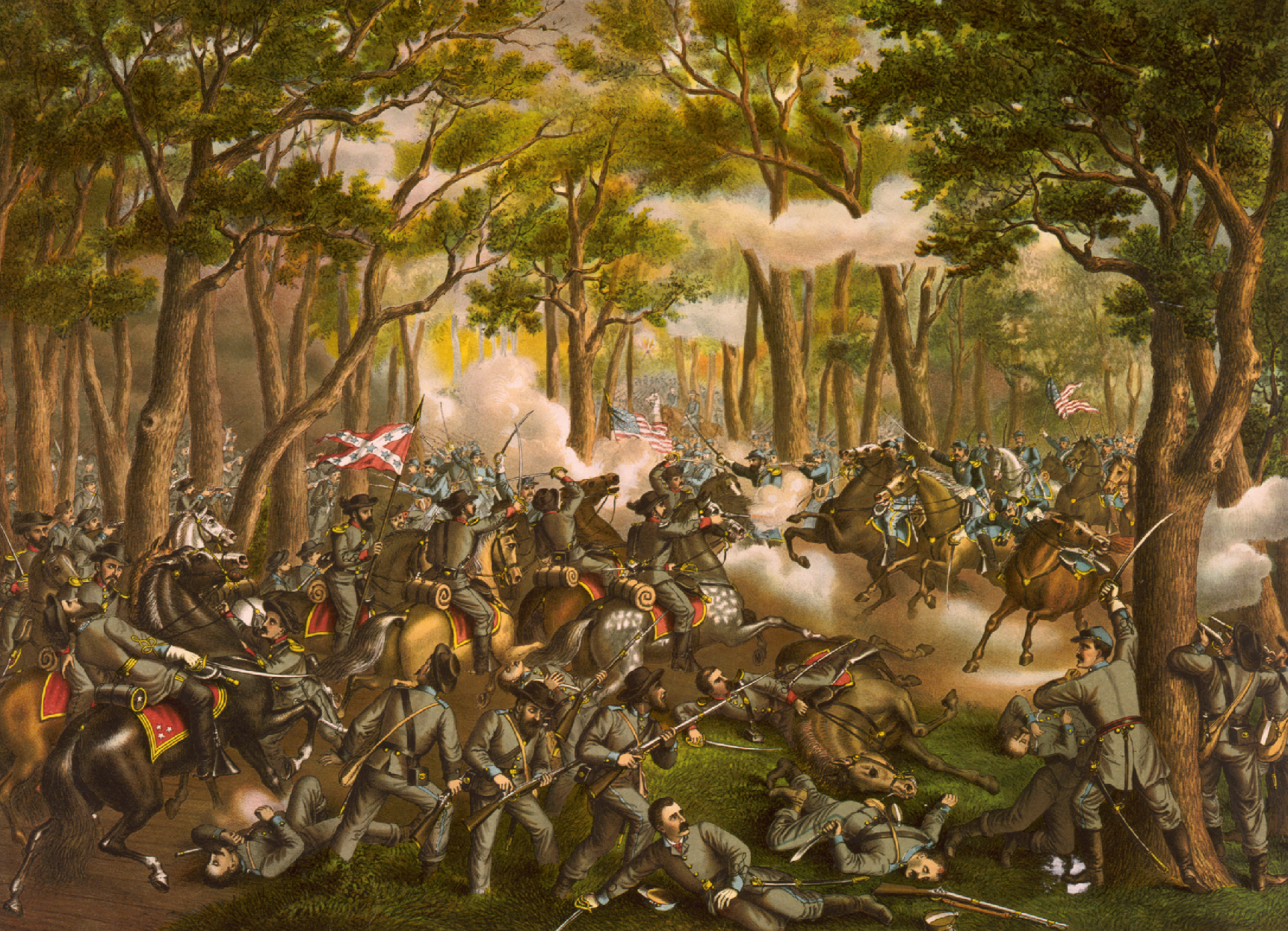
Showing posts with label general grant. Show all posts

Monday, January 16, 2023

Battle of Belmont (November 7, 1861) Part III: Grant on the Run


Grant had finally given his men a battle. They had for the most part acquitted themselves well, though discipline broke down once they reached Camp Johnston. They had tasted victory. Now they would taste defeat and its consequences.


Comic strip I found (https://emergingcivilwar.com/2021/08/05/the-battle-of-belmont-as-told-in-a-comic-strip/)

From Advance to Withdrawal

One consequence of the Federals’ premature celebration in Camp Johnston was that the Confederates, lying along the riverbank to the northeast, had time to collect and rally themselves.[1] Though he groused about it in his memoirs, Grant did not mention his force’s breakdown in discipline in report. He instead claimed that Belmont was on low ground and would be battered by enemy cannon fire. With no wagons to carry all the captured goods, he ordered the camp set on fire. The Federals carried with them captured horses and dragged off three artillery pieces. Just after the flame started the Confederates opened fire from across the river. They reasoned that since the camp was coming on fire there was no Confederates there. One shell from the Lady Polk, one of the larger pieces, struck the ground and caused Grant’s horse to whinny and rear up.[2]

When the Confederates later returned they found burned bodies of wounded men left behind in the tents. They believed the Federals had murdered them upon discovery and then left their corpses to burn alongside their dwellings. More likely the Federals failed to notice them or forgot them, so that they were burned alive. In addition to the rumors that they had bayoneted many of the wounded, this incensed and drove the Confederates. [3]

Thursday, January 12, 2023

Battle of Belmont (November 7, 1861) Part II: Grant on the Attack


The Battle of Belmont can be divided into two phases: The Federals on the attack and the Federals on the retreat. This section covers the former. It was Grant’s first significant battle and the only one where he would be around the front line. Despite this, he is fairly absent from the drive on Belmont. Even in Nathaniel C. Hughes’ comprehensive study of the battle it is usually McClernand or Dougherty who make the wider decisions. Grant appears to have been content to devise the general battle plan and then let his subordinates take initiative. Most accounts place him staying in close proximity to Dougherty, and he did come under fire many times, with one horse shot out from under him. Likely he gave general directions to his brigade commanders and approved their choices, which were sound up to the taking of Camp Johnston.

Monday, January 9, 2023

Battle of Belmont (November 7, 1861) Part I: The Set-Up

In late 1861 Grant sported a longer beard. This photo also shows him well-dressed. This is a stark difference from the more humbly-dressed and shorter-bearded soldier that most are familiar with.

In most of the years between his departure from the Army and his return in the Civil War, Ulysses S. Grant had become a sad, obscure figure. His attempts to forge a career consistently came to naught, and in 1861 he was working as a clerk at his father’s store. Thanks to his West Point background and Mexican War experience, he suddenly became valued when war erupted. Even then it took special help from Illinois Congressman Elihu Washburne to get him a commission as colonel.

Grant quickly settled back into the role as an army officer. He performed creditably in Missouri, whipping his regiment into shape, fostering good relations with the civilians of a divided state, and looking for scattered pro-Confederate militia to defeat or drive off. Though he had fought no considerable battle, he got a promotion to brigadier-general and command over the District of Southeast Missouri. Soon one of America’s most famous generals would have his first battle as commander.


Where Three States Meet

Grant’s jurisdiction was not just southeast Missouri, but the southern tip of Illinois and possibly the Kentucky shore on the Mississippi River.  At first it seemed that his main opponent was General M. Jeff Thompson. Thompson commanded a division of the Confederate-aligned Missouri State Guard. Instead of uniting with Price’s main army of militia, Thompson waged guerilla-style warfare in his part of Missouri. As for Kentucky, both sides of the Civil War wooed it, but the border slave state remained inflexibly neutral. Union and Confederate forces struggled to restrain their desires to plant troops in the state. Whoever violated Kentucky’s neutrality first could send it into the arms of the opposition (see my post on Mill Springs for more background on this situation). Fortunately for the Union, the Confederate commanders in western Tennessee were not the Southern Cause’s best.          


                                Gideon Pillow                                                             Leonidas Polk

One of them was General Gideon Pillow. Pillow was the only general which Grant openly despised in his recollections of the war. Pillow was of aggressive temperament and yearned for glory. In the summer of 1861 he planned to fortify Columbus, Kentucky. With its high banks, Columbus provided an ideal place to control traffic along the northern Mississippi. It was also close to Cairo, Illinois, which stood at the junction of the Mississippi and Ohio Rivers. North and south of Columbus stood 150 foot high bluffs. To the south were the Chalk Bluffs. To the north were ones with strains of iron. These were called the Iron Banks, and stood between Columbus and any Union thrust from Cairo.

Wednesday, September 28, 2022

Kurz & Allison Part VIII: Overland Campaign

When Ulysses S. Grant became commander of all Federal forces at the start of 1864, he chose to personally oversee operations in Virginia, practically commanding the Army of the Potomac (General George Meade was still the technical commander, causing tension among the Union leadership). The ensuing campaign, which lasted through May and most of June, was a constant, hellish series of battles that saw high casualty rates among both Federals and Confederates.

Battle of the Wilderness

The Wilderness is a wooded area. In fact it is part of the terrain over which the Battle of Chancellorsville was fought. Grant planned to get around Lee by quickly penetrating the dense forest. General Lee, however, blocked him on May 5 and a confusing and bloody battle ensued. It looked like the Federals would push through anyways on May 6, but reinforcements under General James Longstreet stopped them. The weather was dry and the vegetation caught on fire, burning many of the wounded alive. Tactically the Wilderness was a Confederate victory, but Grant simply marched his arm southeast and continued the campaign. His plan was to wear down Lee’s force through sheer attrition, as the North could much more easily replace its losses.

Thursday, August 11, 2022

Kurz & Allison Part VI: The Battles for Chattanooga

 Given that he operated out of Chicago, it was only natural that Kurz would focus much of his work on the glorious moments of the Army of the Cumberland (Illinoisans and other Midwesterners were heavily represented in this army) in the Chattanooga and Atlanta Campaigns. He extensively covered the former, producing a lithograph for three of the main actions outside the Tennessee transportation hub. First, we’ll look at the battle that turned General George Thomas into a national hero.

Battle of Chickamauga


In the summer of 1863 General William Rosecrans’ Army of the Cumberland skillfully maneuvered General Braxton Bragg’s Army of Tennessee out of Chattanooga. Though Rosecrans captured all his objectives in Tennessee, the War Department was annoyed that he had not brought the Confederates into a major battle so he could crush them. Feeling intense political pressure, Rosecrans marched into Georgia. James Longstreet’s Corps arrived from Virginia to bolster Bragg’s force and the Confederates attacked the Federals near the creek of Chickamauga. Thanks to a mix-up, the Federals accidentally opened a hole in their line. The Confederates exploited this and shattered their right flank. General Thomas was able to form a defensive line on Snodgrass Hill and hold off the enemy so the rest of the army could escape. For this he was called the “Rock of Chickamauga.” Occurring on September 19-20, it was the second bloodiest battle of the Civil War and the largest (albeit pyrrhic) Confederate victory in the western theatres.

Thursday, July 21, 2022

Kurz & Allison Part V: The Summer of ’63

 Mid-1863 saw several battles and campaigns that put military momentum solidly with the Union. Many consider this the turning of the tide, though it can be argued that the Union  was once on the verge of winning in mid-1862 and the Confederacy actually made some comebacks in 1864.

Battle of Chancellorsville


After restoring morale and efficiency within the Army of the Potomac, General Joseph Hooker attempted a flanking movement across the Rappahannock against Lee’s Confederate forces. He actually placed the heavily outnumbered Lee in a tricky situation near Chancellorsville at the start of May 1863. On May 2 General “Stonewall” Jackson executed an incredible flank march that routed the Union right. Jackson was hit by friendly fire (he would actually die of pneumonia instead of his wounds) while Hooker suffered a concussion that affected his judgment. The next day the Confederates were able to drive the Federals back across the river. Despite accomplishing one of his most celebrated victories, Lee believed that he could not afford any more such bloody battles.

Kurz focuses on the events of May 2. He shows the Union troops withdrawing towards the background, where artillery covers their retreat. The centerpiece, however, is the wounded Jackson. It looks like he’s been hit by a lucky enemy bullet rather than friendly fire. All the Confederate soldiers are ahead of him attacking the Federals. Also, Jackson was hit at night while reconnoitering ahead of his lines, not during  the height of the daylight action. Obviously Kurz wanted to show the infamous shooting while still displaying a battle vista.

Battle of Champion Hills


This is the first of two lithographs covering the Vicksburg Campaign. After a string of failures to take the last Rebel bastion on the Mississippi River, General Ulysses S. Grant finally put together his magnum opus. With the help of the Navy he was able to quickly slip his army from north to south of Vicksburg and cross back over the Mississippi (into the state of the same name). What followed was a string of battles where Grant defeated disunified Confederate forces. Champion Hill (called Champion Hills for the lithograph) was one of the more crucial encounters. On May 16 Grant struck General Louis Pemberton’s main force at the considerable height of Champion Hill. The Federals first flanked and then smashed through the Confederate lines, taking the nearby crossroads. The battle forced Pemberton towards Vicksburg with no escape route, ensuring a siege.

I am not as acquainted with this battle so I might miss a couple inaccuracies or neat references to real locations and figures. The Confederates in the foreground are notably more diverse in their clothing, especially the prisoners. Those on the right in front of the formidable Champion Hill sport a battle flag with inverted colors for St. Andrew’s Cross and the stars. The mounted figure leading his men on with his hat is General John Logan, who got into the Confederates’ flank. Logan was a political general from Illinois who enjoyed more success than others of his kind, possibly because his aggression worked well with Grant and Sherman’s battle plans.

The Battle of Gettysburg

The bloodiest (and almost largest) battle on North American soil, Gettysburg occurred from July 1 to 3. Lee, looking for a quick blow to end the war, invaded the North for the second time. Through a series of mistakes and circumstances, the two sides blindly struck each other north of the crossroads town of Gettysburg, Pennsylvania. On the first day Confederates pushed the Federals south through the town. The Army of the Potomac, now under General George Meade, took the heights south of town and narrowly repulsed a series of attacks on the second day. The third day cemented the Confederate defeat when Lee’s major assault on the Union center turned into a bloodbath. This was the first and perhaps only massive tactical defeat for Lee.

As with most artists who choose one part of the battle, Kurz focuses on Pickett’s Charge, the ill-devised July 3 assault on Cemetery Ridge. This is definitely one of his more cluttered works and I have to say not as striking. Masses of men from both sides advance from the sides of the lithograph. A wrecked Union battery shows the work of the incredible pre-assault bombardment (which was actually ineffective thanks to untested ordnance). A clump of Confederate prisoners are escorted off while a thick line of men snakes over the stone wall. The fence along Emmitsburg Road can be made out behind a shell-struck group of Rebels. If the dying officer on horseback is supposed to be General Lewis Armistead, Kurz forgot he was on foot for the whole charge.

Siege of Vicksburg

The Siege of Vicksburg lasted from May 18 to July 4. Grant made several attempts to take the city by force, all of which failed. Bombardments, though terrifying to the civilians, also did not wear down Confederate resistance. It was starvation that finally forced the loss of the city. Pemberton was supposed to get relief from General Joseph Johnston to the east, but Johnston dallied. Relief attempts from the Trans-Mississippi came too late and ended in defeat anyways. On July 3 Pemberton opened up talks of surrender, which were finalized the following day. Combined with the defeat at Gettysburg, this was a disaster for the Confederacy, giving the Union unrestricted access along the Mississippi River.

This is one of the more placid works, though there is still some action. Shells burst among the entrenchments and Union gunboats patrol the Mississippi River. For once some of the soldiers are shown not fighting. Many are actually lounging about, in great contrast to all the activity on the left side of the lithograph. In the right foreground an officer directs Grant’s attention (to what we don’t know). A Confederate party carrying a white flag emerges from the trees. It could be a flag of surrender, but the tiny red cross in one corner indicates it may be something else.