Showing posts with label ulysses s grant. Show all posts

Thursday, June 11, 2026

Americas 250th Birthday Cinemathon #29: Son of the Morning Star (1991)


I’ve actually already written a review of this one, so this is a revised version with a little more to it. Son of the Morning Star is a two-part TV adaptation of Evan S. Connell's non-fiction book of the same name. The title is one of the Cheyenne names for Colonel George Custer, who led a daytime assault on their camp on the Washita River. I was originally drawn to this film after watching the heavily inaccurate Errol Flynn as Custer flick They Died with Their Boots On. Unfortunately the mini-series (which did not perform to expectations) has still not received a cleaned up DVD or streaming release, so I had to watch a VHS rip on Youtube (yes, it's completely free, albeit with some ad breaks). While the picture quality is fuzzy, I have to say that I was very pleased with this "movie" and feel that it deserves more attention for being the most accurate coverage of Custer and Little Bighorn. I’ve even rewatched it twice.

George Armstrong Custer literally joined the American Civil War out of West Point. His audacious bravery propelled his career, and he ended the war as both a brevet general of volunteers and one of General Phil Sheridan’s favorites. With the army shrinking, he was shunted down to the rank of colonel (a common problem for many who earned extra start leading volunteers in the Civil War) and was sent out West to deal several Indian wars. Custer’s vanity and recklessness often got him into hot water with his superiors, but it was his last stand and death at the Little Bighorn that ensured he would be remembered for all of American history.

Friday, June 5, 2026

Americas 250th Birthday Cinemathon #27: Lincoln (2012)


Steven Spielberg’s Lincoln was one of his long-running projects. Earlier on, it was to be a more general biopic with Liam Neeson as the famed Abraham Lincoln. By the time it finally swung into proper production, however, Neeson dropped out and Daniel Day-Lewis took his place. Wisely, Spielberg also abandoned the idea of a film covering years, if not decades, of Lincoln’s life, a common mistake of biopics that results in unfocused, hole-ridden storylines. Instead he zeroed in on the president’s attempt to get the 13th Amendment passed in the House of Representatives.

The 13th Amendment was to end slavery once and for all in the United States. It was the culmination of years of policy development during the Civil War. Though he hated slavery, Lincoln knew he could not abolish it and instead had supported the Republican Party’s views of preventing its expansion into new territories. As the war progressed, however, the Union Army and Federal government could not ignore the fact that slave labor fueled the Confederacy, so runaway slaves were accepted as “contraband” enemy property. By 1865 many now believed that slavery had to be abolished, whether out of moral concerns or the pragmatic belief that it would result in more strife down the road.

The 13th Amendment is opposed by various Democrats and some of the more conservative Republicans. A greater threat is a Confederate peace commission. If slavery’s continued existence in a restored Union ensures that a long, bloody war can finally end right now, many in the House will see the 13th as a guaranteed war to keep the body count going. Many historians disputed the central conflict of Lincoln, arguing that there was no way slavery could remain intact after the Civil War, even if the amendment initially failed to pass.

Monday, January 16, 2023

Battle of Belmont (November 7, 1861) Part III: Grant on the Run


Grant had finally given his men a battle. They had for the most part acquitted themselves well, though discipline broke down once they reached Camp Johnston. They had tasted victory. Now they would taste defeat and its consequences.


Comic strip I found (https://emergingcivilwar.com/2021/08/05/the-battle-of-belmont-as-told-in-a-comic-strip/)

From Advance to Withdrawal

One consequence of the Federals’ premature celebration in Camp Johnston was that the Confederates, lying along the riverbank to the northeast, had time to collect and rally themselves.[1] Though he groused about it in his memoirs, Grant did not mention his force’s breakdown in discipline in report. He instead claimed that Belmont was on low ground and would be battered by enemy cannon fire. With no wagons to carry all the captured goods, he ordered the camp set on fire. The Federals carried with them captured horses and dragged off three artillery pieces. Just after the flame started the Confederates opened fire from across the river. They reasoned that since the camp was coming on fire there was no Confederates there. One shell from the Lady Polk, one of the larger pieces, struck the ground and caused Grant’s horse to whinny and rear up.[2]

When the Confederates later returned they found burned bodies of wounded men left behind in the tents. They believed the Federals had murdered them upon discovery and then left their corpses to burn alongside their dwellings. More likely the Federals failed to notice them or forgot them, so that they were burned alive. In addition to the rumors that they had bayoneted many of the wounded, this incensed and drove the Confederates. [3]

Thursday, January 12, 2023

Battle of Belmont (November 7, 1861) Part II: Grant on the Attack


The Battle of Belmont can be divided into two phases: The Federals on the attack and the Federals on the retreat. This section covers the former. It was Grant’s first significant battle and the only one where he would be around the front line. Despite this, he is fairly absent from the drive on Belmont. Even in Nathaniel C. Hughes’ comprehensive study of the battle it is usually McClernand or Dougherty who make the wider decisions. Grant appears to have been content to devise the general battle plan and then let his subordinates take initiative. Most accounts place him staying in close proximity to Dougherty, and he did come under fire many times, with one horse shot out from under him. Likely he gave general directions to his brigade commanders and approved their choices, which were sound up to the taking of Camp Johnston.

Monday, January 9, 2023

Battle of Belmont (November 7, 1861) Part I: The Set-Up

In late 1861 Grant sported a longer beard. This photo also shows him well-dressed. This is a stark difference from the more humbly-dressed and shorter-bearded soldier that most are familiar with.

In most of the years between his departure from the Army and his return in the Civil War, Ulysses S. Grant had become a sad, obscure figure. His attempts to forge a career consistently came to naught, and in 1861 he was working as a clerk at his father’s store. Thanks to his West Point background and Mexican War experience, he suddenly became valued when war erupted. Even then it took special help from Illinois Congressman Elihu Washburne to get him a commission as colonel.

Grant quickly settled back into the role as an army officer. He performed creditably in Missouri, whipping his regiment into shape, fostering good relations with the civilians of a divided state, and looking for scattered pro-Confederate militia to defeat or drive off. Though he had fought no considerable battle, he got a promotion to brigadier-general and command over the District of Southeast Missouri. Soon one of America’s most famous generals would have his first battle as commander.


Where Three States Meet

Grant’s jurisdiction was not just southeast Missouri, but the southern tip of Illinois and possibly the Kentucky shore on the Mississippi River.  At first it seemed that his main opponent was General M. Jeff Thompson. Thompson commanded a division of the Confederate-aligned Missouri State Guard. Instead of uniting with Price’s main army of militia, Thompson waged guerilla-style warfare in his part of Missouri. As for Kentucky, both sides of the Civil War wooed it, but the border slave state remained inflexibly neutral. Union and Confederate forces struggled to restrain their desires to plant troops in the state. Whoever violated Kentucky’s neutrality first could send it into the arms of the opposition (see my post on Mill Springs for more background on this situation). Fortunately for the Union, the Confederate commanders in western Tennessee were not the Southern Cause’s best.          


                                Gideon Pillow                                                             Leonidas Polk

One of them was General Gideon Pillow. Pillow was the only general which Grant openly despised in his recollections of the war. Pillow was of aggressive temperament and yearned for glory. In the summer of 1861 he planned to fortify Columbus, Kentucky. With its high banks, Columbus provided an ideal place to control traffic along the northern Mississippi. It was also close to Cairo, Illinois, which stood at the junction of the Mississippi and Ohio Rivers. North and south of Columbus stood 150 foot high bluffs. To the south were the Chalk Bluffs. To the north were ones with strains of iron. These were called the Iron Banks, and stood between Columbus and any Union thrust from Cairo.

Monday, November 14, 2022

Kurz & Allison Part X: 1865

 The Confederacy died in 1865. The major battles of that year were all Union victories and mercifully shortened the war. Louis Kurz shows three of the significant actions which spelled out the death knell of the Confederacy. He also produced a fourth lithograph that to my knowledge has been absent from illustrated histories, likely because it was printed without color and does not encapsulate a battle.

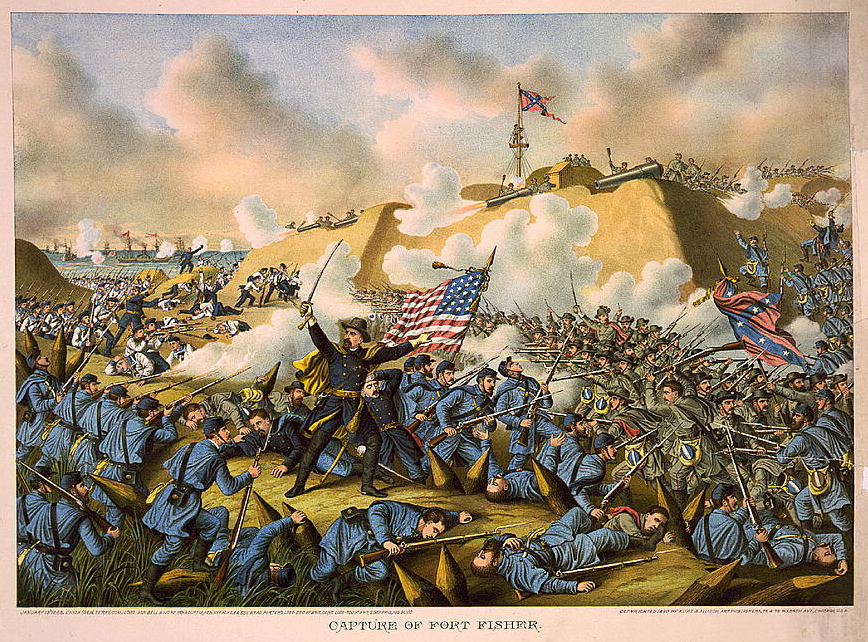
Capture of Fort Fisher

By 1865, the only Confederate port able to receive blockade runners and keep the Confederate forces, especially Lee's Army of Northern Virginia, alive was at Wilmington, North Carolina. The Union had held off on closing this port because the formidable Fort Fisher stood in the way. In early 1865 they finally made a move on it. The Navy under Admiral David Dixon Porter and a Corps of infantry under General Alfred Terry coordinated a controversially unchallenged landing on January 13 and an assault on January 15. Not properly supported by Confederate units miles away, the Confederate garrison under General George Whiting put up a stout defense, but eventually felt compelled to surrender. This cut the last major lifeline to Trans-Atlantic trade.