Monday, September 12, 2022

The Sack of Athens

On May 2, 1862, a brigade of Union soldiers descended on Athens, a small town and transportation hub in northern Alabama. What ensued was one of the earliest incidents of hard war against civilians, at a time when Union military policy stressed policies that would win ostensibly reluctant Secessionists back into the Union. The man at the center of this controversy was Colonel John Turchin, known by his detractors as the Mad Cossack.


The Mad Cossack
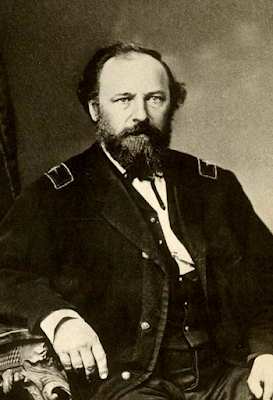

John Basil Turchin was the Americanized name of Ivan Vasilyevich Turchaninov. Turchaninov was born in the Province of the Don (the historical domain of the Cossacks) on January 30, 1822. His father was a major in the Imperial Russian Army and a lower-ranking noble. Ivan thus got into a good school, where he excelled. At the age of 14 he followed his father into the military, rising to colonel of the Imperial Guard in 1841. In 1849 he helped quash a revolution in Hungary. One historian notes that the soldiers’ large scale theft of food from the peasants was approved of as initiative by their commanders, as they were having trouble bringing their own stores of food up to the front. This might have played a role in Turchin’s mindset 30 years later.

During the Crimean War (1853-1856) he first earned a position on the personal staff of crown prince Alexander and then established defenses along the Finnish coast (Finland was at this time part of the Russian Empire). In 1856 Turchaninov married Nedezhda Lvova, an aristocrat’s daughter he had met in Poland. Around this time Turchaninov began to chafe at the military system in Russia. It promoted men through the ranks by nature of their birth and connections rather than merit. It also got in the way of much needed reforms. As a competent officer unable to rise any higher because of his comparatively modest background, Ivan was especially frustrated by the Russian Imperial order. He and Nedezhda, both liberal Russians, decided to move away from their homeland and its firm class system. They sought life in the United States. There the ex-soldier gained his Anglicized name while running a farm in New York. Once he and his wife learned English they moved to Chicago where he used his military experience to become an engineer.[1]

Movie Review: Medieval (2022)


Medieval is a Czech film made in the English language and theatrically released in the States (it’s out as of the time of this review). The title is rather broad and simple (it’s like calling a film set within the last couple centuries Modern) but considering that the average American won’t know anything about the specific events depicted it’s just as well. I was drawn to this movie because it takes place in Bohemia, the land of my paternal ancestors. Czech director Petr Jakl focuses on the rise of Jan Zizka (Ben Foster), a famed Czech military hero, prior to the Hussite Wars (1418-1434). The Hussite Wars were a series of struggles within the Holy Roman Empire. These were centered in Bohemia, where theologian Jan Hus presaged the Protestant Reformation with his calls for church reform and an emphasis on Scripture over leading clergymen for authority.

Since Medieval’s narrative precedes the wars, Jan Hus is off to the side, but his criticisms of church and politics does tie into one of the story’s central conflicts, which is how the common people are victimized by the machinations of Papal and royal politics. In the early 15th Century the Roman Catholic Church is split between two popes, one in Rome and the other in France, and the title of Holy Roman Emperor is unoccupied. This results in violent chaos throughout Europe. In an attempt to reunite the Church under Rome and stabilize Europe, Lord Bores (Michael Caine) plans to have Zizka escort Bohemian King Wenceslas IV (Karl Roden) to Rome where he will be crowned Holy Roman Emperor. Scheming King Sigismund of Hungary (Matthew Goode) also has his eyes on the throne, and forms an antagonistic alliance with tyrannical Bohemian nobleman Rosenberg (Til Schweiger). In an attempt to neutralize Rosenberg, Lord Bores has Zizka abduct his French fiancĂ©e Catherine (Sophie Lowe). Thanks to a series of double-crosses and Sigismund’s own agenda, Zizka and his mercenaries end up allying with peasant rebels against Sigismund and his nasty mercenary leader Torak (Roland Moller). If you think this is hard to follow, you’re correct. If you don’t have any decent historical knowledge of this period in history you might find yourself lost.

Friday, August 26, 2022

10 Myths & Misconceptions: Gettysburg

 No battle of the Civil War has captured the popular imagination more than the three-day affair at Gettysburg (July 1-3). As the quintessential battle of the War Between the States, if not American history in general, thousands of participants and contemporary writers were eager to maximize the drama through incredible or moving stories. Commanding officers were keen to enhance or restore their reputations and often sought to tear down others’. As a result, the events at Gettysburg have given rise to plenty of myths, most of which were credulously (though sometimes understandably) reported as fact by historians and documentarians.


#1: The Confederates Came to Gettysburg for Shoes


The story is that divisional commander General Henry Heth heard of a shoe factory in Gettysburg. Desperate to find footwear for the bare feet of his soldiers, he ordered a force towards the town for this express purpose. Thus the greatest battle of the Civil War began over shoes. This is a nice story showing how simple causes can lead to massive effects. However, Heth’s report states that he ordered his men into town to find all manners of supplies, shoes included. He added “especially shoes” because, for men marching hundreds of miles, exposed feet were a major concern. The Confederates would have had to scour the shops or try to take from civilians to find them, because Gettysburg in fact had no shoe factory.


#2: The Dutch Run Again

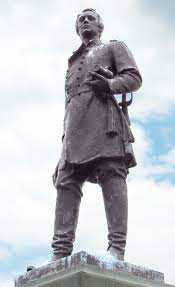
Statue of Francis Barlow at Gettysburg

Throughout July 1 the Union Army sent reinforcements north of Gettysburg to form a line and meet the also gradually expanding Confederate force. The defensive line, which had been holding up nicely, finally came undone when the German immigrants of the XI Corps panicked and fled, enabling the Confederates to unravel it and send the Unions running through town. The Germans, or “Dutch,” ran just like they did at Chancellorsville when Stonewall Jackson had marched into their flank. It was not cowardice that lost the first day of Gettysburg, however. It was in fact a tactical blunder on the part of General Francis Barlow, a divisional commander. Instead of connecting his left flank with Carl Schurz’s division, he advanced to the height of Blocher’s Knoll so the enemy could not use it. What resulted was an overextended salient which the Confederates were able to break through. The largely German XI Corps had no choice but to retreat with Confederates pouring into their right flank. Some critics also (more incorrectly) claimed that these men almost lost Cemetery Hill on July 2 by running again.

Wednesday, August 24, 2022

Kurz & Allison Part VII: Black Regiments

 Many white Union veterans had a deep respect for their black comrades in arms (check out Barbara Gannon’s The Won Cause, which shows how discrimination against blacks among veterans’ organizations was actually the exception rather than the rule). Louis Kurz was evidently among them, as he depicted black soldiers in a favorable light. I’ve already covered his use of helpful black civilians in the Monitor-Merrimac lithograph. This section contains three examples covering events from mid-1863 to early 1864.

Storming Fort Wagner

The summer of 1863 saw many attempts to capture the birthplace of secession: Charleston, South Carolina. In July General Quincy A. Gilmore sought to force Fort Sumter’s capture or surrender by seizing Morris Island and its Battery Wagner as a launching pad. The Federals landed on the island, but were not able to take the main objective. On July 18 the 54th Massachusetts, a regiment with Abolitionist white officers and mostly free northern blacks in the enlisted ranks, led a costly assault on Battery Wagner. The heavily outnumbered Confederates managed to repel the Union assault and only protracted siege warfare led to their abandonment of their post. Though a defeat, the battle proved to many that black soldiers could fight just as well as whites.

Indian Territory, 1862 Part III: Battle of Old Fort Wayne


Newtonia Taken

Newtonia was a big battle in terms of the Trans-Mississippi and the victors were enthused. A history of Shelby’s cavalry claimed that their victory “was decisive.”[1] This was hardly the case. While Salomon had been roundly beaten, his defeat did nothing to halt Union operations. He had simply gotten far ahead of thousands of other troops under his superior blunt and under Totten. The next day, October 1, General Blunt arrived with reinforcements. Schofield also departed Springfield and caught up with Totten’s division. Schofield took charge and ordered Blunt and Totten’s divisions to converge on Newtonia with their 12,000 men. An attack was projected at dawn on October 4. Colonel Douglas Cooper, aware of the oncoming Federals, called on General Rains for reinforcements. Rains said none could arrive. On October 3 part of Shelby’s brigade rode out and captured a few pickets, only to learn that Totten’s division was bearing down on them. On the same day Rains ordered Cooper to withdraw from Newtonia.

Nearby at Granby, Major Buster, who had barely made it in time to participate in the battle of September 30, also encountered advance elements of the Union and put up a short fight before retreating to Newtonia. Buster could not find any superior officer and took command himself, ordering Howell to deploy. Shelby showed up and prepared a defense. The civilians who had found themselves in the center of the last fight heard what was coming and fled into the prairie with their valuables. As it turned out Shelby wisely decided to retreat and he and the others headed south. Thus the Confederates abandoned the town that they had fought so long and hard to keep just a few days earlier.[2] These events also undid the Confederate concentration in southwest Missouri. General Hindman now planned to collect his forces in Northern Arkansas and then return to its northern neighbor. In the meantime Blunt had his eyes on the Arkansas-Indian Territory border.

Monday, August 22, 2022

Indian Territory, 1862 Part II: Battle of Newtonia


Road to Newtonia

While the Federals lost their foothold in Indian Territory, the rest of the Department of Kansas focused on developments in Missouri and Arkansas. Major General Samuel R. Curtis held overall command in this portion of the Trans-Mississippi, with General John Schofield managing affairs in the field with Blunt’s Frontier Division and General James Totten’s Missouri Division.  Southern forces under General Thomas Hindman had fortified Arkansas and by the end of August had formed a line along the border with Missouri. At any time they could make forays there to take advantage of that state’s forage and mills. Cooper played a role in this. Taking advantage of the Federal withdrawal in the latter half of July, he occupied a space in northeastern Indian Territory ten miles west of its border with Missouri. In response Blunt ordered Colonels Salomon and Weer to take their brigades south and look for possible signs of invasion. These various forces were in position for a small, but notable battle at the town of Newtonia. Though this town was in Missouri, not Indian Territory, I feel that it should be included because it shows how the Confederate Indians participated with the territory again back in their hands. It also set the stage for the next Federal entry.[1]

In preparation for his planned campaign in Missouri, Hindman directed several of his subordinates, including those in Indian Territory, to gain a foothold in the southwestern corner of the state, with an eye towards acquiring the Granby lead mines (helpful in creating ammunition).[2] The Confederates occupied a line across southern Missouri that paralleled the Arkansas border. One notable site was of course Granby and its lead mines. Newtonia lay east, to the south, and further south of that was Camp Coffee, where Shelby’s Missourians gathered. Roughly north of Newtonia was Sarcoxie, where in a few days Union army and militia units concentrate. The general area was noted for its mills, which produced vital cereal crops for man and animal alike.[3]

Thursday, August 11, 2022

Kurz & Allison Part VI: The Battles for Chattanooga

 Given that he operated out of Chicago, it was only natural that Kurz would focus much of his work on the glorious moments of the Army of the Cumberland (Illinoisans and other Midwesterners were heavily represented in this army) in the Chattanooga and Atlanta Campaigns. He extensively covered the former, producing a lithograph for three of the main actions outside the Tennessee transportation hub. First, we’ll look at the battle that turned General George Thomas into a national hero.

Battle of Chickamauga


In the summer of 1863 General William Rosecrans’ Army of the Cumberland skillfully maneuvered General Braxton Bragg’s Army of Tennessee out of Chattanooga. Though Rosecrans captured all his objectives in Tennessee, the War Department was annoyed that he had not brought the Confederates into a major battle so he could crush them. Feeling intense political pressure, Rosecrans marched into Georgia. James Longstreet’s Corps arrived from Virginia to bolster Bragg’s force and the Confederates attacked the Federals near the creek of Chickamauga. Thanks to a mix-up, the Federals accidentally opened a hole in their line. The Confederates exploited this and shattered their right flank. General Thomas was able to form a defensive line on Snodgrass Hill and hold off the enemy so the rest of the army could escape. For this he was called the “Rock of Chickamauga.” Occurring on September 19-20, it was the second bloodiest battle of the Civil War and the largest (albeit pyrrhic) Confederate victory in the western theatres.